
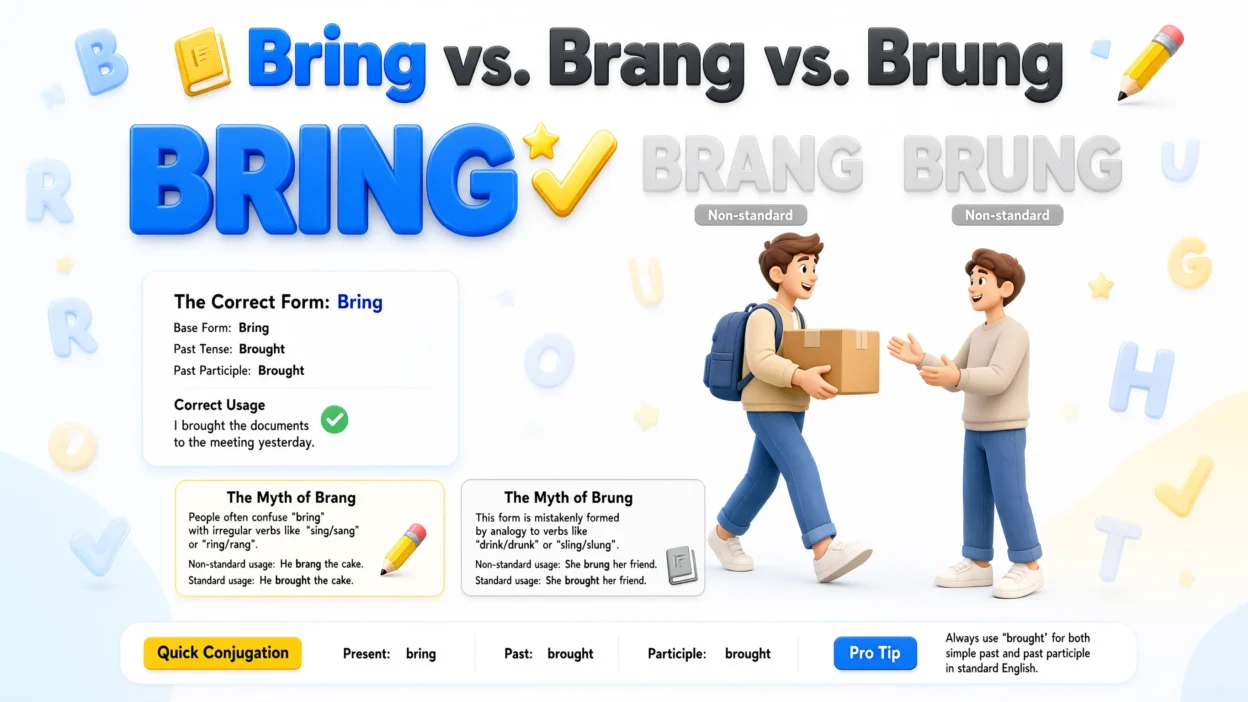
Have you ever wondered if the past tense of bring is brang, brung, or brought? These three forms sound similar, so it is easy to mix them up in everyday conversations. However, only one is the standard past-tense form in modern English. The correct past tense and past participle of bring is brought.
The words brang and brung are sometimes heard in informal speech, regional dialects, and casual conversations, but they are not accepted as standard forms in formal English. Understanding the difference will help you speak and write more confidently.
If you are learning English, improving your grammar, or preparing for an exam, this guide explains each form, shows how to use bring correctly, and provides practical examples to help you remember the right word.
Quick Answer: Is It Bring, Brang, or Brung?
Brought is the correct standard past tense and past participle of bring. The verb follows an irregular pattern: bring (present), brought (past), and brought (past participle). Brang and brung are nonstandard forms sometimes used in informal or dialectal speech, but they should be avoided in formal writing.
Why Do People Confuse Bring, Brang, and Brung?
People confuse these words because English has many irregular verbs with different past-tense patterns.
For example:
- Sing → Sang → Sung
- Ring → Rang → Rung
- Drink → Drank → Drunk
- Bring → Brought → Brought
Since bring rhymes with sing and ring in the present tense, some English speakers mistakenly assume that its past tense should follow the same pattern.
This leads to forms such as brang and brung. However, the standard English form is always brought.
1. Bring: Meaning, Definition, and Usage
Bring is the present-tense form of an irregular verb. It means to carry, take, or accompany someone or something to a particular place, usually toward the speaker or the person being addressed.
It is commonly used in everyday conversations, instructions, requests, and descriptions of actions.
Examples:
- Please bring your notebook to class.
- I bring lunch to work every day.
- Can you bring me a glass of water?
- They bring their children to the park.
- We always bring gifts to birthday parties.
Verb forms:
- Base form: Bring
- Past tense: Brought
- Past participle: Brought
- Present participle: Bringing
- Third-person singular: Brings
Remember that bring describes an action happening in the present or a general habit.
2. Brang: Meaning, Definition, and Usage
Brang is a nonstandard past-tense form of bring. Some people use it in informal conversations or regional varieties of English.
It probably develops through confusion with verbs such as sing → sang and ring → rang.
However, brang is not considered the correct standard past tense of bring.
Examples of nonstandard usage:
- He brang his lunch to school.
- She brang her brother to the party.
- They brang some flowers for us.
- I brang my homework yesterday.
Correct standard versions:
- He brought his lunch to school.
- She brought her brother to the party.
- They brought some flowers for us.
- I brought my homework yesterday.
Important: You may encounter brang in casual speech, dialogue, or regional storytelling. However, use brought in school assignments, professional writing, examinations, and formal conversations.
3. Brung: Meaning, Definition, and Usage
Brung is another nonstandard form sometimes used as the past tense or past participle of bring.
It is often associated with informal speech and dialects. Its formation may be influenced by verbs such as sing → sung and ring → rung.
Although people sometimes use it naturally in conversation, it is not the standard English form.
Examples of nonstandard usage:
- I brung my books to class.
- She brung some food for everyone.
- He has brung his dog along.
- They brung everything we needed.
Correct standard versions:
- I brought my books to class.
- She brought some food for everyone.
- He has brought his dog along.
- They brought everything we needed.
In standard English, use brought instead of brung, whether you are describing a completed action or using the present perfect tense.
Bring vs Brang vs Brung: Comparison Table
| Word | Standard English? | Usage |
| Bring | Yes | Present tense |
| Brang | No | Nonstandard past-tense form |
| Brung | No | Nonstandard past or past participle form |
| Brought | Yes | Past tense and past participle |
The most important distinction is that bring is the base form, while brought is used for both the simple past and past participle.
When Should You Use Bring, Brang, and Brung?
Choosing the right verb form depends on the tense and the type of English you are using.
When to Use Bring
Use bring when describing present actions, habits, instructions, or future-related actions.
Examples:
- Please bring your ID card.
- I bring my lunch from home.
- She will bring her laptop tomorrow.
When to Use Brang
Brang is a nonstandard form found in some informal or regional speech.
Avoid it in standard English writing. Replace it with brought.
When to Use Brung
Brung is also nonstandard. It may appear in dialectal conversations, but it should not be used in formal English.
Use brought instead.
15 Examples of Bring and Brought in Sentences
The following examples show how to use the correct forms of bring in everyday English.
| No. | Sentence |
| 1 | Please bring your notebook tomorrow. |
| 2 | She brought flowers for her mother. |
| 3 | I bring my lunch to work every day. |
| 4 | He brought his younger brother to school. |
| 5 | They have brought everything we need. |
| 6 | Can you bring me some water? |
| 7 | We brought our friends to the party. |
| 8 | My father brings fresh fruit every Sunday. |
| 9 | She has brought a new book for me. |
| 10 | I brought my umbrella because it was raining. |
| 11 | Please bring your documents to the office. |
| 12 | The teacher brought extra books for students. |
| 13 | He will bring his camera tomorrow. |
| 14 | They brought delicious food to the picnic. |
| 15 | Your kind words brought me happiness. |
These examples demonstrate that bring is used for present and future actions, while brought describes completed actions and works as a past participle.
Common Mistakes When Using Bring, Brang, and Brung
English learners often make mistakes when changing bring into the past tense.
Here are some common errors and their corrections.
Mistake 1: Using brang instead of brought
- Incorrect: She brang her bag yesterday.
- Correct: She brought her bag yesterday.
Mistake 2: Using brung instead of brought
- Incorrect: He has brung his lunch.
- Correct: He has brought his lunch.
Mistake 3: Using bring for a completed past action
- Incorrect: I bring my books yesterday.
- Correct: I brought my books yesterday.
Mistake 4: Using brought after did
- Incorrect: Did you brought your notebook?
- Correct: Did you bring your notebook?
Mistake 5: Using bring after has or have
- Incorrect: She has bring some food.
- Correct: She has brought some food.
Grammar tip: After did, use the base form bring. After has, have, or had, use the past participle brought.
Easy Memory Trick to Remember Bring and Brought
The easiest way to remember the correct forms is to memorize this simple pattern:
Bring → Brought → Brought
Present
Bring
Today
Past
Brought
Yesterday
Past Participle
Brought
Has brought
Remember: Both the simple past and past participle use the same word: brought.
You can also remember this example:
- Today, I bring my bag.
- Yesterday, I brought my bag.
- I have brought my bag.
Practicing these three sentences will help you remember the correct verb forms.
Bring vs Brang vs Brung in American and British English
The standard form of the verb bring is the same in both American and British English.
| English Variety | Present | Past | Past Participle |
| American English | Bring | Brought | Brought |
| British English | Bring | Brought | Brought |
There is no standard American or British grammar rule that makes brang or brung correct past-tense forms.
You might hear these forms in regional dialects or informal conversations in different English-speaking communities. However, brought remains the correct choice in standard American and British English.
Similar Words and Irregular Verbs to Learn
If you find bring, brang, and brung confusing, learning other irregular verbs can improve your understanding of English grammar.
Here are some useful examples:
| Present | Past | Past Participle |
| Sing | Sang | Sung |
| Ring | Rang | Rung |
| Drink | Drank | Drunk |
| Swim | Swam | Swum |
| Begin | Began | Begun |
| Run | Ran | Run |
| Take | Took | Taken |
| Give | Gave | Given |
| Write | Wrote | Written |
| Buy | Bought | Bought |
| Think | Thought | Thought |
| Catch | Caught | Caught |
Notice that sing, ring, and drink follow patterns that might make brang and brung seem logical. However, bring has its own irregular form: brought.
Final Verdict: Bring, Brang, or Brung?
The correct standard English forms are bring for the present tense and brought for both the simple past tense and past participle.
- Bring: Correct present-tense form.
- Brang: Nonstandard past-tense form.
- Brung: Nonstandard past or past participle form.
- Brought: Correct standard past tense and past participle.
If you want to speak and write proper standard English, always choose brought instead of brang or brung when describing a past action.
FAQs:
1. Is brang a real word?
Brang is used by some English speakers in informal conversations and regional dialects. However, it is not the standard past tense of bring. The correct standard form is brought.
2. Is brung grammatically correct?
Brung is a nonstandard form of bring. Although it appears in some dialects and casual speech, it is not accepted as the standard past tense or past participle. Use brought instead.
3. What is the past tense of bring?
The past tense of bring is brought.
Example: She brought her books to school yesterday.
4. What is the past participle of bring?
The past participle of bring is also brought.
Example: I have brought everything you requested.
5. Is it bring, brang, or brung?
Bring is the correct present-tense form, while brang and brung are nonstandard forms. For the past tense and past participle, use brought.
6. Why do people say brang instead of brought?
People may say brang because they associate bring with verbs such as sing → sang and ring → rang. However, bring follows a different irregular pattern.
7. Is brought the same in American and British English?
Yes. Both American and British English use brought as the past tense and past participle of bring. There is no difference in the standard verb forms.
Remember This
- Bring = Present tense.
- Brought = Simple past tense.
- Brought = Past participle.
- Brang = Nonstandard form.
- Brung = Nonstandard form.
The correct pattern is Bring → Brought → Brought.
Conclusion
Understanding the difference between bring, brang, and brung is easier when you remember that brought is the correct standard past tense and past participle of bring. Although brang and brung may appear in informal conversations and regional dialects, they should not replace brought in standard English.
Keep practicing the examples and remember the simple pattern: bring, brought, brought. With regular practice, you will become more confident using this irregular verb in everyday conversations, school assignments, and professional writing.

I am Ryan Mitchell, an author at Instahuts passionate about creating engaging Instagram bio ideas. I enjoy helping readers express their personality through creative, stylish, and unique bios that make every profile stand out.