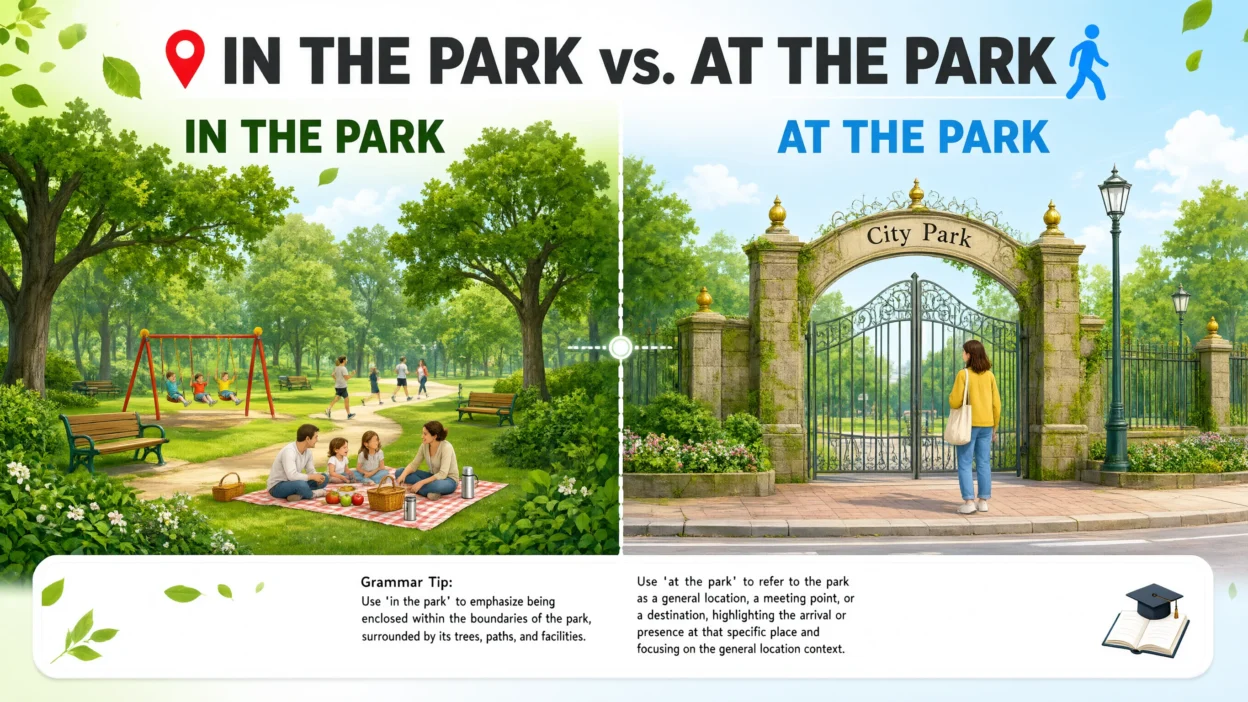
Choosing between “in the park” and “at the park” can be confusing for English learners because both phrases describe being in a park. Although they are grammatically correct, they are not always used in the same way. The difference depends on what you want to emphasize: being inside the park or being at that location.
“In the park” generally emphasizes being within the physical boundaries of a park. For example, The children are playing in the park. On the other hand, “at the park” focuses on the park as a particular location or meeting place. For example, I will meet you at the park.
Understanding this small difference can help you speak and write more naturally. In this guide, you will learn the meanings, grammatical uses, practical examples, common mistakes, and differences between these two expressions.
Quick Answer: In the Park or At the Park?
Both “in the park” and “at the park” are correct English expressions. Use “in the park” when emphasizing that someone or something is physically inside the park. Use “at the park” when referring to the park as a general location or destination. The correct choice depends on the context.
Why Do People Confuse “In the Park” and “At the Park”?
People often confuse these expressions because both use the same noun, “park,” and refer to the same general location.
The confusion comes from the different meanings of the prepositions “in” and “at.”
- In describes being inside an area or enclosed space.
- At identifies a particular place or location.
For example:
- She is sitting in the park. (Emphasizes her position inside the park.)
- She is at the park. (Emphasizes her current location.)
Both sentences are grammatically correct, but they communicate slightly different ideas.
1. What Does “In the Park” Mean?
“In the park” means being inside the physical area or boundaries of a park.
The preposition “in” is used when you want to emphasize that someone or something is within a particular space.
It is especially common when describing activities, movements, objects, or people inside a park.
Examples of “In the Park” in Sentences:
- The children are playing in the park.
- We had a wonderful picnic in the park.
- There are many beautiful flowers in the park.
- A dog is running in the park.
- She enjoys walking in the park every morning.
- I saw some birds in the park.
- They planted several trees in the park.
- The workers are cleaning the paths in the park.
When Should You Use “In the Park”?
Use this expression when:
- Someone is physically inside a park.
- You describe activities happening within the park.
- You talk about objects, animals, or plants inside the park.
- You want to emphasize the park’s physical space.
Easy Tip: If you can imagine someone or something inside the park’s boundaries, “in the park” is usually appropriate.
2. What Does “At the Park” Mean?
“At the park” means being at the location of a park.
The preposition “at” identifies a place where someone is, goes, or meets another person. It focuses more on the location than on being physically inside its boundaries.
This expression is common in everyday conversations, especially when discussing plans, meetings, and activities.
Examples of “At the Park” in Sentences:
- I am at the park with my friends.
- We will meet at the park tomorrow.
- My parents are waiting for me at the park.
- She spends her weekends at the park.
- The children are at the park today.
- Let’s have lunch at the park.
- He met his classmates at the park.
- I left my bicycle at the park.
When Should You Use “At the Park”?
Use this expression when:
- You identify someone’s general location.
- You talk about meeting someone at a park.
- You describe visiting or going to a park.
- You discuss plans or arrangements involving a park.
Easy Tip: If you are answering the question “Where are you?” and simply identifying the park as your location, “at the park” is often a natural choice.
In the Park vs At the Park: Comparison Table
Here is a simple comparison to help you understand the difference.
| Feature | In the Park | At the Park |
| Meaning | Inside the park | At the park’s location |
| Preposition | In | At |
| Main focus | Physical space | General location |
| Usage | Activities and surroundings | Meetings and visits |
| Example | Kids are playing in the park. | We are at the park. |
| Emphasis | Inside an area | Being at a place |
Both expressions are correct. The main difference is the focus of the sentence.
When Should You Use “In the Park” or “At the Park”?
Choosing the correct expression becomes easier when you understand the situation.
Use “In the Park” for Activities Inside the Area
When describing something happening within the park, “in” is often the better choice.
Examples:
- The children are running in the park.
- We saw a beautiful butterfly in the park.
- People are exercising in the park.
- There is a small lake in the park.
Use “At the Park” for Locations and Meetings
When referring to a park as a destination or meeting place, “at” is often more natural.
Examples:
- I will see you at the park.
- My brother is waiting at the park.
- We spent the afternoon at the park.
- They are meeting their friends at the park.
Can You Use Both Expressions in the Same Situation?
Yes! Both expressions can describe the same situation from different perspectives.
For example:
- We are at the park. (We are identifying our location.)
- We are in the park. (We are emphasizing that we are inside the park.)
The difference is not always about physical location. It is often about what the speaker wants to emphasize.
15 Examples of “In the Park” and “At the Park”
Let’s look at more practical examples to understand how these expressions work in everyday English.
| No. | Sentence | Correct Phrase |
| 1 | The children are playing ___ the park. | In |
| 2 | I will meet you ___ the park. | At |
| 3 | There are many trees ___ the park. | In |
| 4 | My friends are ___ the park right now. | At |
| 5 | We had a picnic ___ the park. | In |
| 6 | She is waiting for me ___ the park. | At |
| 7 | I saw a squirrel ___ the park. | In |
| 8 | They spend every Sunday ___ the park. | At |
| 9 | A beautiful fountain is ___ the park. | In |
| 10 | Let’s meet ___ the park at 5 p.m. | At |
| 11 | We enjoyed walking ___ the park. | In |
| 12 | My father is ___ the park with his friends. | At |
| 13 | There is a playground ___ the park. | In |
| 14 | I met my teacher ___ the park yesterday. | At |
| 15 | The birds are singing ___ the park. | In |
Important: Some sentences can naturally use either preposition depending on the intended meaning. The table shows the most suitable choice for the intended emphasis.
Common Mistakes When Using “In the Park” and “At the Park”
English learners sometimes use these expressions interchangeably without considering their meanings.
Here are some mistakes to avoid.
Mistake 1: Thinking Only One Phrase Is Correct
Incorrect understanding: “In the park” is always correct, while “at the park” is wrong.
Correct understanding: Both expressions are grammatically correct.
Mistake 2: Using “In” for Every Location
Example:
- Less natural for a meeting arrangement: I will meet you in the park.
- Also correct: I will meet you at the park.
Both can work, but “at the park” emphasizes the park as the meeting location.
Mistake 3: Using “At” When Describing Something Inside
Example:
- The flowers are in the park. (Natural when describing where the flowers grow.)
- The flowers are at the park. (Possible, but less precise about their position.)
Mistake 4: Forgetting the Article “The”
When referring to a specific park, use the article “the.”
- Correct: We are in the park.
- Correct: We are at the park.
However, article usage can change when a park has a proper name or is used in another grammatical construction.
Memory Trick: How to Remember the Difference
Here is an easy trick to remember these expressions:
- IN = INSIDE: Think about being physically inside the park.
- AT = LOCATION: Think about identifying the park as a place.
Remember these two examples:
- Playing in the park = Playing inside the park.
- Meeting at the park = Meeting at that location.
This simple trick will help you choose the right expression in most everyday situations.
American English vs British English: Is There a Difference?
Both “in the park” and “at the park” are commonly used in American and British English.
There is no major grammatical difference between the two varieties regarding these expressions.
| Expression | American English | British English |
| In the park | Correct | Correct |
| At the park | Correct | Correct |
| Playing in the park | Natural | Natural |
| Meeting at the park | Natural | Natural |
| Walking in the park | Natural | Natural |
The choice depends on the intended meaning and context, not on whether you are speaking American or British English.
Similar Expressions You Should Know
Understanding related expressions can improve your knowledge of English prepositions.
Here are some useful examples:
1. In the Garden vs At the Garden
- In the garden: Inside the garden area.
- At the garden: At a particular garden location.
2. In the School vs At School
- In the school: Inside the school building.
- At school: At the school location, usually for study or work.
3. In the Office vs At the Office
- In the office: Inside the office space.
- At the office: At the workplace location.
4. In the Restaurant vs At the Restaurant
- In the restaurant: Inside the restaurant.
- At the restaurant: At the restaurant location.
5. In the Beach vs At the Beach
- On the beach: On the sandy or shore area.
- At the beach: At the beach location.
Remember that English prepositions do not always follow one fixed rule. Their meanings can change depending on the noun and the context.
Final Verdict: In the Park or At the Park?
The correct choice is both “in the park” and “at the park.” Neither expression is wrong.
Use “in the park” when you want to emphasize being physically inside the park or describe activities and things within it.
Use “at the park” when you want to identify the park as a general location, destination, or meeting place.
The easiest way to remember:
- In the park = Inside the park.
- At the park = At the park’s location.
Choose the expression that communicates your intended meaning most clearly.
FAQs:
1. Is it correct to say “in the park” or “at the park”?
Yes, both expressions are grammatically correct. “In the park” emphasizes being inside the park, while “at the park” identifies the park as a location or destination.
2. What is the difference between “in the park” and “at the park”?
The main difference is emphasis. “In the park” focuses on the physical space inside the park. “At the park” focuses on the park as a particular location.
3. Should I say “I am in the park” or “I am at the park”?
Both are correct. Say “I am in the park” when emphasizing that you are inside the park. Say “I am at the park” when simply telling someone your location.
4. Is “playing at the park” grammatically correct?
Yes. “Playing at the park” is grammatically correct and commonly used in everyday English. It identifies the park as the location of the activity. “Playing in the park” emphasizes playing within the park’s physical area.
5. Do Americans say “at the park” or “in the park”?
Americans commonly use both expressions. The choice depends on context. “At the park” is common when identifying a location, while “in the park” often describes activities happening inside it.
6. Can I say “We had a picnic at the park”?
Yes! “We had a picnic at the park” is perfectly natural English. You can also say “We had a picnic in the park.” Both are correct, although the second emphasizes the physical setting.
7. Which is more natural: “meet me in the park” or “meet me at the park”?
Both are natural. “Meet me at the park” identifies the park as the meeting location. “Meet me in the park” can suggest meeting somewhere inside the park.
Remember This
- In the park = Inside the physical boundaries of a park.
- At the park = At the park as a location or destination.
- Both expressions are grammatically correct.
- Use “in” to emphasize the space.
- Use “at” to emphasize the location.
- Context determines which expression sounds more natural.
Conclusion
Understanding the difference between “in the park” and “at the park” is simple once you learn how the prepositions “in” and “at” work. Both expressions are correct, but they communicate slightly different meanings. “In the park” focuses on being inside the park, while “at the park” identifies the park as a general location.
As you continue learning English, pay attention to how these expressions are used in everyday conversations. Practice with simple sentences such as “The children are playing in the park” and “I will meet you at the park.” With regular practice, you will become more confident using English prepositions correctly.

I’m Ethan Carter, Administrator at Instahuts. I manage content quality, improve user experience, and ensure every Instagram bio resource is accurate, creative, and helpful for users building standout online profiles.