Understanding the difference between imply and infer can make your English clearer and help you avoid common communication mistakes. These two words are closely related because both describe how people communicate ideas, meanings, and messages. However, they have different roles in a conversation.
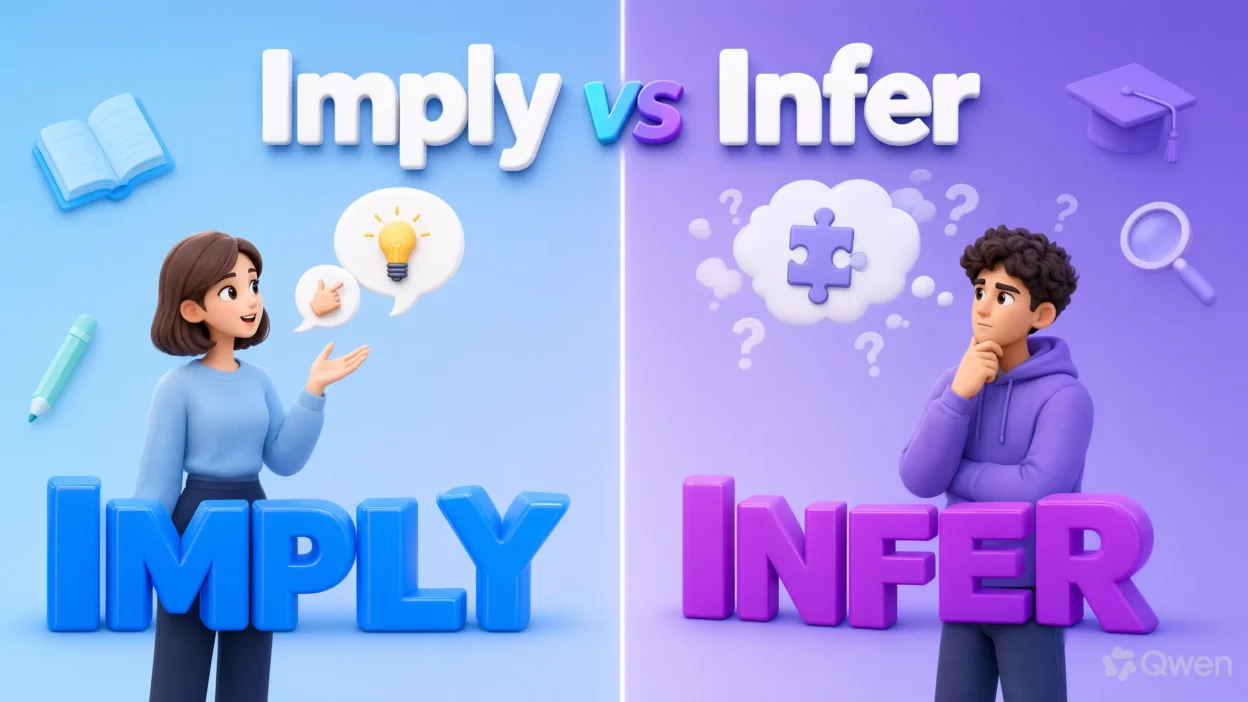
The main difference is that imply means to suggest something indirectly without saying it directly, while infer means to understand or conclude something from clues, evidence, or information. In simple terms, a speaker or writer implies something, and a listener or reader infers it.
For example, if someone says, The room is getting cold, they might imply that the window should be closed. If you understand that hidden message, you infer that they want you to close the window.
Learning when to use each word will help you speak, write, and communicate more accurately. Let’s explore their meanings, differences, examples, and common mistakes.
Quick Answer: Imply vs. Infer
Imply means to suggest or communicate an idea indirectly without expressing it openly. Infer means to understand or draw a conclusion based on clues, evidence, or information. A speaker implies a message, while a listener infers its meaning. Remember: the person giving the hint implies, and the person receiving the hint infers.
Why Do People Confuse Imply and Infer?
People often confuse these words because they describe two connected parts of communication.
Both involve messages that may not be directly stated. However, they describe different actions:
- Imply: Giving someone a hint or suggesting something indirectly.
- Infer: Understanding a hint or reaching a conclusion from available information.
Think about a conversation between two friends.
Friend A says, You have been spending a lot of time on your phone lately.
Friend B understands that Friend A might be suggesting they should spend less time on their phone.
Here:
- Friend A implies that Friend B uses their phone too much.
- Friend B infers that Friend A is concerned about their phone usage.
The difference becomes easier when you remember who is sending the message and who is understanding it.
What Does Imply Mean?
Imply is a verb that means to suggest something indirectly rather than stating it clearly.
When someone implies something, they communicate an idea through their words, tone, actions, or context. The listener may need to understand the hidden meaning.
Simple Definition of Imply
To imply means to hint at something or suggest an idea without saying it directly.
Examples of Imply in Sentences
- Her smile seemed to imply that she already knew the answer.
- Are you trying to imply that I made a mistake?
- His comments imply that he disagrees with the decision.
- The teacher’s expression seemed to imply disappointment.
- She didn’t say no, but her silence seemed to imply hesitation.
When Should You Use Imply?
Use imply when someone indirectly communicates an idea, feeling, opinion, or suggestion.
Common situations include:
- Conversations: Someone hints at something without saying it directly.
- Writing: An author suggests an idea through words or descriptions.
- Body language: A person’s expressions or gestures communicate an indirect message.
- Discussions: Someone suggests an opinion without openly expressing it.
Remember: The person who sends or communicates the indirect message implies something.
What Does Infer Mean?
Infer is a verb that means to reach a conclusion or understand something using clues, facts, evidence, or information.
When you infer something, you think about what you know and use it to understand something that has not been directly explained.
Simple Definition of Infer
To infer means to figure something out or draw a conclusion based on available information.
Examples of Infer in Sentences
- I inferred from his expression that he was unhappy.
- We can infer that the meeting was canceled because nobody arrived.
- The detective inferred that the door had been opened recently.
- From her tone, I inferred that she was upset.
- Readers can infer the character’s feelings from the story.
When Should You Use Infer?
Use infer when someone reaches a conclusion based on available information rather than receiving a direct explanation.
Common situations include:
- Reading: Understanding an author’s hidden message.
- Conversations: Figuring out what someone really means.
- Investigations: Drawing conclusions from evidence.
- Education: Using facts and clues to understand information.
- Everyday life: Making reasonable guesses based on observations.
Remember: The person who receives or interprets the indirect message infers something.
Imply vs. Infer: Comparison Table
The easiest way to understand these words is to compare their meanings, roles, and uses.
| Feature | Imply | Infer |
| Meaning | To suggest indirectly | To draw a conclusion |
| Action | Communicating a hint | Understanding a hint |
| Role | Sender | Receiver |
| Focus | Giving information | Interpreting information |
| Based on | Words, tone, or actions | Clues, facts, or evidence |
| Example | She implied that I was late. | I inferred that she was upset. |
| Synonyms | Suggest, hint, indicate | Conclude, deduce, determine |
The key difference: Imply is about what someone communicates, while infer is about what someone understands.
When to Use Imply vs. Infer
Although these words are connected, choosing the correct one depends on the action you want to describe.
Use Imply When Someone Gives a Hint
Choose imply when a person, writer, or situation suggests something without stating it directly.
Examples:
- Are you implying that I am not working hard enough?
- The advertisement implies that this product will save time.
- His words implied that he wanted to leave early.
- The author implies that money cannot buy happiness.
Use Infer When Someone Draws a Conclusion
Choose infer when someone understands something from available clues or information.
Examples:
- I inferred from her voice that she was tired.
- The students inferred the meaning of the poem.
- We can infer that the business is doing well from its recent growth.
- The police inferred that the suspect had left the building.
Can You Use Both Words in One Sentence?
Yes! In fact, using both words together is an excellent way to understand their relationship.
Examples:
- The manager implied that changes were coming, and the employees inferred that some positions might be affected.
- She implied that she was disappointed, so I inferred that I had made a mistake.
- The author implied that the character was lonely, and readers inferred this from his behavior.
15 Examples of Imply vs. Infer in Sentences
Here are practical examples that show how these words work in everyday English.
Examples of Imply
- My friend implied that I needed a haircut.
- The teacher implied that our homework was incomplete.
- His message implied that he was unhappy with the results.
- She implied that we should arrive earlier.
- The manager implied that a promotion might be possible.
- The movie implies that honesty is important.
- Are you implying that I am responsible for this problem?
- His silence seemed to imply that he disagreed.
Examples of Infer
- I inferred from his silence that he was angry.
- She inferred that the shop was closed because the lights were off.
- We can infer that he is experienced from his work.
- The students inferred the answer from the passage.
- I inferred from her smile that she was happy.
- Readers can infer the story’s message from its ending.
- The detective inferred that someone had entered the house.
- They inferred that the event had been postponed.
Common Mistakes When Using Imply and Infer
Even fluent English speakers sometimes mix up these words. Understanding the following mistakes will help you use them correctly.
Mistake 1: Using Infer When You Mean Imply
Incorrect: She inferred that I was lazy.
This sentence means she reached a conclusion that you were lazy. If you mean she indirectly suggested that you were lazy, use implied.
Correct: She implied that I was lazy.
Mistake 2: Using Imply When You Mean Infer
Incorrect: I implied from his expression that he was upset.
Correct: I inferred from his expression that he was upset.
The second sentence is correct because you reached a conclusion from his expression.
Mistake 3: Thinking Both Words Have the Same Meaning
These words are related, but they are not interchangeable.
- The speaker implies a message.
- The listener infers the message.
Using the wrong word can change the meaning of your sentence.
Mistake 4: Forgetting Their Past Tense Forms
Both words are regular verbs.
| Present | Past | -ing Form |
| Imply | Implied | Implying |
| Infer | Inferred | Inferring |
Notice the spelling changes:
- Imply becomes implied, with a y changing to i.
- Infer becomes inferred, with a doubled r.
What Is an Easy Memory Trick for Imply vs. Infer?
A simple memory trick can help you remember the difference without memorizing complicated definitions.
Imply = Indirectly send a message.
Infer = Interpret or understand a message.
Remember this simple rule:
- The speaker implies.
- The listener infers.
Think of a teacher saying, Some students need to spend more time studying.
The teacher may be implying that certain students are not preparing enough.
A student might infer that the teacher is talking about them.
Another helpful reminder:
Imply starts with I, and Infer also starts with I, but think of the actions:
- Imply = Give a hint.
- Infer = Get the hint.
Is There a Difference Between Imply and Infer in American and British English?
No significant difference exists between the meanings of imply and infer in American and British English.
Both varieties use these words in the same general way:
- Imply: To suggest something indirectly.
- Infer: To reach a conclusion from information or evidence.
The spelling is also the same in both varieties.
| Word | American English | British English |
| Imply | Imply | Imply |
| Implied | Implied | Implied |
| Infer | Infer | Infer |
| Inferred | Inferred | Inferred |
| Inferring | Inferring | Inferring |
Both American and British speakers follow the same communication rule: the sender implies, and the receiver infers.
What Are Similar Words to Imply and Infer?
Several English words have similar meanings to imply and infer. However, they are not always interchangeable.
Synonyms of Imply
- Suggest: To present an idea indirectly.
- Hint: To communicate something without saying it openly.
- Indicate: To show or point toward something.
- Insinuate: To suggest something, often in an indirect or unpleasant way.
- Allude: To refer to something indirectly.
Example: His comments suggested that he was unhappy with the decision.
Synonyms of Infer
- Conclude: To reach a decision or judgment based on information.
- Deduce: To work out an answer through logical reasoning.
- Determine: To establish something after examining the facts.
- Decipher: To understand something that is difficult to interpret.
- Gather: To understand something from available information.
Example: I concluded from her reaction that she disliked the idea.
Imply vs. Infer vs. Assume
These three words are sometimes confused, but their meanings are different.
| Word | Meaning | Example |
| Imply | Suggest indirectly | He implied that I was wrong. |
| Infer | Draw a conclusion from clues | I inferred that he disagreed. |
| Assume | Accept something as true without sufficient proof | I assumed that he was angry. |
The main distinction is that inferring involves interpreting available information, while assuming may involve accepting something without enough evidence.
Final Verdict: Imply vs. Infer
The difference between imply and infer is simple once you understand their roles in communication.
- Imply means to suggest something indirectly.
- Infer means to understand or conclude something from clues or evidence.
If someone gives you a hint, they imply something. If you understand that hint, you infer something.
Remember that the speaker implies and the listener infers. This simple rule will help you choose the correct word in conversations, writing, schoolwork, and professional communication.
FAQs:
1. What is the main difference between imply and infer?
The main difference is that imply means to suggest something indirectly, while infer means to understand or conclude something from available information. A speaker implies a message, and a listener infers its meaning.
2. Does a speaker imply or infer?
A speaker implies something. When someone communicates an idea indirectly through words, tone, or actions, they are implying a message.
Example: The teacher implied that the students needed more practice.
3. Does a listener imply or infer?
A listener infers something. They use the speaker’s words, expressions, or other clues to understand the intended meaning.
Example: I inferred from his tone that he was upset.
4. Can imply and infer be used in the same sentence?
Yes. Both words can appear in the same sentence because they describe two connected actions.
Example: She implied that she was disappointed, and I inferred that I had made a mistake.
5. Is infer the opposite of imply?
They are not exact opposites, but they describe opposite sides of communication. Imply involves suggesting a message, while infer involves interpreting that message.
6. What is the past tense of imply and infer?
The past tense of imply is implied, and the past tense of infer is inferred.
Examples:
- She implied that something was wrong.
- I inferred that she was upset.
7. What is the difference between infer and assume?
Infer means to reach a conclusion using clues, information, or evidence. Assume means to accept something as true without necessarily having enough evidence.
Example:
- I inferred from the dark clouds that it might rain.
- I assumed the event was canceled without checking.
Remember This
- Imply = Give a hint.
- Infer = Understand a hint.
- Speakers and writers imply.
- Listeners and readers infer.
- Implied is the past tense of imply.
- Inferred is the past tense of infer.
The easiest rule: You imply something to someone, and they infer something from what you communicate.
Conclusion
Understanding imply vs. infer is important for clear and accurate English communication. Although both words relate to indirect messages, they describe different actions. Imply means suggesting an idea without directly expressing it, while infer means reaching a conclusion from clues, words, or evidence. Remembering the difference between the sender and receiver makes these words much easier to use.
With regular practice, you can confidently use both words in conversations, essays, professional writing, and everyday situations. Just remember: people imply messages, and others infer their meanings.

I am Ryan Mitchell, an author at Instahuts passionate about creating engaging Instagram bio ideas. I enjoy helping readers express their personality through creative, stylish, and unique bios that make every profile stand out.