Have you ever wondered if to write considered to be or considered as? Both expressions appear in English, but they are not always interchangeable. Choosing the correct one depends on the sentence structure and what you want to express.
The phrase considered to be is generally the more natural and widely accepted choice when describing how someone or something is regarded, believed, or judged. For example, The book is considered to be a classic. The expression considered as can also be correct, particularly when describing something in a particular role, capacity, or way of viewing it.
However, in many everyday sentences, using as after considered is unnecessary or awkward. Understanding this small grammatical difference can help you write more clearly and confidently.
Quick Answer
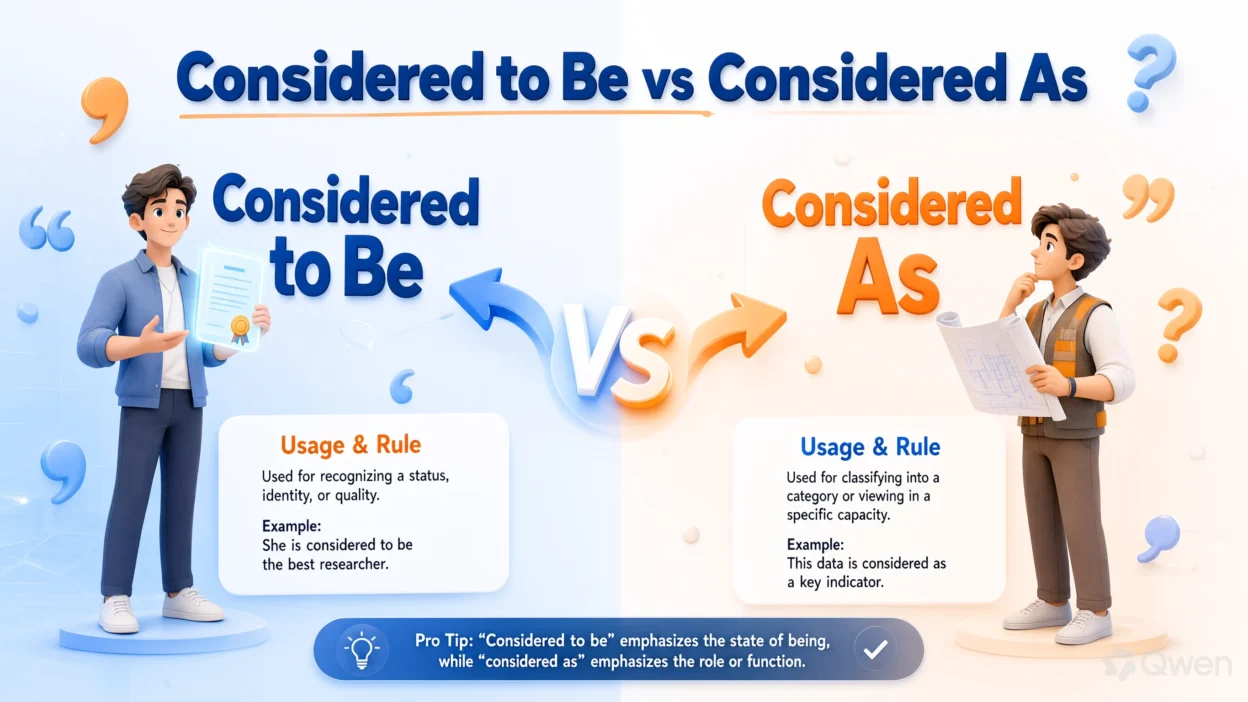
Considered to be is generally used to describe what someone or something is believed or regarded to be. Considered as is used when presenting someone or something in a particular role, capacity, or context. In everyday English, considered to be is usually the safer and more natural choice.
Why Do People Confuse Considered to Be and Considered As?
People often confuse these expressions because both involve the verb consider, which means to think about, judge, or regard something in a particular way.
The confusion usually comes from translating expressions directly from other languages or assuming that as is always necessary after considered.
However, English grammar uses different structures depending on the meaning:
- Considered to be: Expresses an opinion, judgment, or belief about someone’s identity or nature.
- Considered as: Highlights a particular role, function, capacity, or perspective.
- Considered: Can often stand alone without an additional preposition or phrase.
Understanding these patterns makes it easier to choose the right expression.
First Word: Considered to Be
Considered to be means regarded, believed, or judged to have a particular quality, identity, or status.
It is commonly used in formal writing, academic discussions, everyday conversations, and professional communication.
The structure is:
Subject + be + considered + to be + noun/adjective
Examples:
- She is considered to be an excellent teacher.
- This city is considered to be one of the safest places to live.
- He is considered to be very intelligent.
- The painting is considered to be a masterpiece.
- Exercise is considered to be important for good health.
In these sentences, the expression communicates how someone or something is generally regarded.
When Is Considered to Be Used?
Use considered to be when:
- You want to describe someone’s identity or status.
- You are expressing a general opinion or judgment.
- You are discussing someone’s qualities or characteristics.
- You are writing academic or professional sentences.
- You want to explain how something is commonly regarded.
More examples:
- Shakespeare is considered to be one of the greatest writers in English literature.
- This method is considered to be effective.
- She is considered to be a talented musician.
Second Word: Considered As
Considered as is used when something or someone is viewed in a particular role, capacity, or context.
It places emphasis on the perspective from which a person or thing is evaluated.
Examples:
- The proposal was considered as a possible solution.
- His experience should be considered as an important qualification.
- The building is considered as part of the city’s historical heritage.
However, it is important to understand that considered as is not necessary in many sentences where considered alone or considered to be would be more natural.
For example:
- Less natural: She is considered as a talented writer.
- More natural: She is considered to be a talented writer.
- Also natural: She is considered a talented writer.
When Is Considered As Used?
Use considered as when you specifically want to emphasize a role, capacity, or perspective and the sentence structure supports it.
Examples:
- The evidence was considered as part of the investigation.
- His comments were considered as a reflection of the team’s concerns.
- The document should be considered as a historical record.
In modern English, many writers would prefer considered part of the investigation, considered a reflection, or considered a historical record in these examples.
Therefore, do not automatically add as after considered.
Considered to Be vs Considered As: Comparison Table
| Feature | Considered to Be | Considered As |
| Main meaning | Regarded or believed to be | Viewed in a particular capacity |
| Common usage | Very common | More limited |
| Grammar | Considered + to be | Considered + as |
| Focus | Identity, quality, or status | Role or perspective |
| Formal writing | Natural and common | Depends on context |
| Everyday English | Usually preferred | Often unnecessary |
| Example | He is considered to be honest. | It was considered as part of the review. |
Important: Considered can also take a noun or adjective directly without to be or as.
For example:
- She is considered an expert.
- The plan is considered unnecessary.
- He is considered a reliable employee.
When to Use Each: Considered to Be or Considered As?
Choosing between these expressions becomes easier when you understand the meaning of your sentence.
Use Considered to Be for Opinions and Judgments
Choose this expression when describing what someone or something is believed to be.
Examples:
- This restaurant is considered to be expensive.
- She is considered to be a brilliant scientist.
- The discovery is considered to be significant.
Use Considered As for Roles and Perspectives
Use as when the sentence specifically presents something in a particular capacity or context.
Examples:
- The painting was considered as evidence in the case.
- His proposal was considered as an alternative.
- The issue was considered as part of a larger discussion.
In many of these examples, removing as also produces a more natural sentence.
Use Considered Without Either Expression
Sometimes, neither to be nor as is necessary.
Examples:
- He is considered a professional.
- This is considered an important achievement.
- The book is considered a classic.
This is a particularly useful pattern because it keeps sentences concise and natural.
15 Examples of Considered to Be vs Considered As
Here are practical examples to help you understand the difference.
Examples of Considered to Be
- She is considered to be one of the best doctors in the city.
- This book is considered to be a valuable resource.
- He is considered to be an honest person.
- The project is considered to be successful.
- That restaurant is considered to be among the best in town.
- English is considered to be an important international language.
- The invention is considered to be a major achievement.
- My grandfather is considered to be a wise man.
Examples of Considered As
- The proposal was considered as a possible alternative.
- The document was considered as evidence during the investigation.
- His experience was considered as an important factor.
- The building was considered as part of the historical site.
- The suggestion was considered as one option among several.
- Her contribution was considered as an example of excellent teamwork.
- The incident was considered as part of a wider problem.
Remember that several considered as examples can be rewritten without as for a smoother sentence.
Common Mistakes When Using Considered to Be and Considered As
Even experienced English learners sometimes make mistakes with these expressions. Here are some common problems to avoid.
1. Using As Unnecessarily
Incorrect or awkward: She is considered as a great leader.
Better: She is considered to be a great leader.
You can also write:
She is considered a great leader.
2. Adding To Be After As
Incorrect: He is considered as to be an expert.
Correct: He is considered to be an expert.
Do not combine these structures unnecessarily.
3. Forgetting That Considered Can Stand Alone
Less natural: This is considered to be as an important decision.
Better: This is considered an important decision.
4. Using the Wrong Sentence Structure
Incorrect: She considered to be a good student.
Correct: She is considered to be a good student.
Alternatively:
People consider her to be a good student.
The first sentence uses a passive construction, while the second uses an active construction.
5. Assuming Both Expressions Always Mean the Same Thing
Considered to be and considered as do not automatically fit into the same sentences.
Always consider whether you are describing an identity or quality, or emphasizing a particular role or perspective.
Memory Trick: How to Remember the Difference
Here is a simple way to remember these expressions:
- To Be = What Something Is: Use considered to be when describing identity, qualities, or status.
- As = In What Capacity: Use considered as when emphasizing a particular role or perspective.
- No Extra Words: Use considered directly before a noun or adjective when the sentence sounds natural.
For example:
- He is considered to be intelligent.
- He is considered an intelligent person.
- His work was considered as evidence.
Remembering these three patterns will help you avoid most common mistakes.
American vs British English: Is There a Difference?
There is no major grammatical difference between American and British English when using considered to be and considered as.
Both varieties generally prefer considered to be when describing someone’s qualities, identity, or status.
Examples in American English:
- She is considered to be an excellent manager.
- This is considered an important discovery.
Examples in British English:
- She is considered to be an excellent manager.
- This is considered an important discovery.
The main difference is not regional. It is about sentence structure, meaning, and natural usage.
In both varieties, considered as may appear in specific contexts, but it is often unnecessary.
Similar Words and Expressions
Several other expressions can communicate meanings similar to considered to be and considered as.
| Expression | Meaning | Example |
| Regarded as | Viewed or thought of as | He is regarded as an expert. |
| Thought to be | Believed to be | She is thought to be talented. |
| Seen as | Viewed in a particular way | This is seen as progress. |
| Viewed as | Considered from a perspective | He is viewed as a leader. |
| Believed to be | Accepted as probably true | It is believed to be genuine. |
| Recognized as | Accepted or acknowledged as | She is recognized as a professional. |
| Known as | Identified by a name or reputation | He is known as a great artist. |
These expressions can make your writing more varied while keeping your meaning clear.
Final Verdict: Considered to Be or Considered As?
The best choice in most everyday and formal sentences is considered to be.
Use it when describing how someone or something is regarded, judged, or believed to be.
Use considered as when you specifically want to express a role, capacity, or perspective and the sentence calls for that construction. However, remember that as is frequently unnecessary.
You can also use considered directly before a noun or adjective to create shorter, natural sentences.
FAQs:
1. Is It Considered to Be or Considered As?
Considered to be is generally the more natural choice when describing what someone or something is believed or regarded to be. Considered as can be used in particular contexts involving roles or perspectives, but it is often unnecessary.
2. Is Considered As Grammatically Correct?
Yes, considered as can be grammatically correct in certain contexts. It is used when presenting something in a particular capacity or perspective. However, many sentences sound more natural without as.
3. Can I Say Considered to Be?
Yes. Considered to be is a standard and widely used English expression. For example, She is considered to be an excellent student.
4. Can I Use Considered Without To Be or As?
Yes. Considered can directly precede a noun or adjective.
Examples:
- He is considered an expert.
- This is considered important.
- The building is considered historic.
5. What Is the Difference Between Regarded As and Considered To Be?
Both expressions communicate how someone or something is viewed or judged. Regarded as is commonly followed by a noun or role, while considered to be is commonly used to describe an identity, quality, or status.
6. Is Considered to Be Formal or Informal?
Considered to be works in both formal and informal English. It is especially common in academic writing, professional communication, news articles, and everyday conversations.
7. Is Considered As Common in British English?
Considered as does appear in British English, but it is not automatically preferred over considered to be. The correct expression depends on the intended meaning and sentence structure.
Remember This
- Considered to be describes what someone or something is believed to be.
- Considered as emphasizes a particular role, capacity, or perspective.
- Considered can often stand alone before a noun or adjective.
- Do not add as automatically after considered.
- When unsure, considered to be is usually the safer choice for describing identity or qualities.
Conclusion
Understanding the difference between considered to be vs considered as can make your English writing clearer and more natural. Although both expressions have legitimate uses, considered to be is generally preferred when describing someone’s identity, qualities, or status. Considered as is more limited and depends on the context in which you use it.
The easiest way to remember the difference is to focus on your intended meaning. Use considered to be for opinions and judgments, considered as for specific roles or perspectives, and considered alone when it creates a clear sentence. With regular practice, choosing the correct expression will become much easier.

I am Ryan Mitchell, an author at Instahuts passionate about creating engaging Instagram bio ideas. I enjoy helping readers express their personality through creative, stylish, and unique bios that make every profile stand out.