
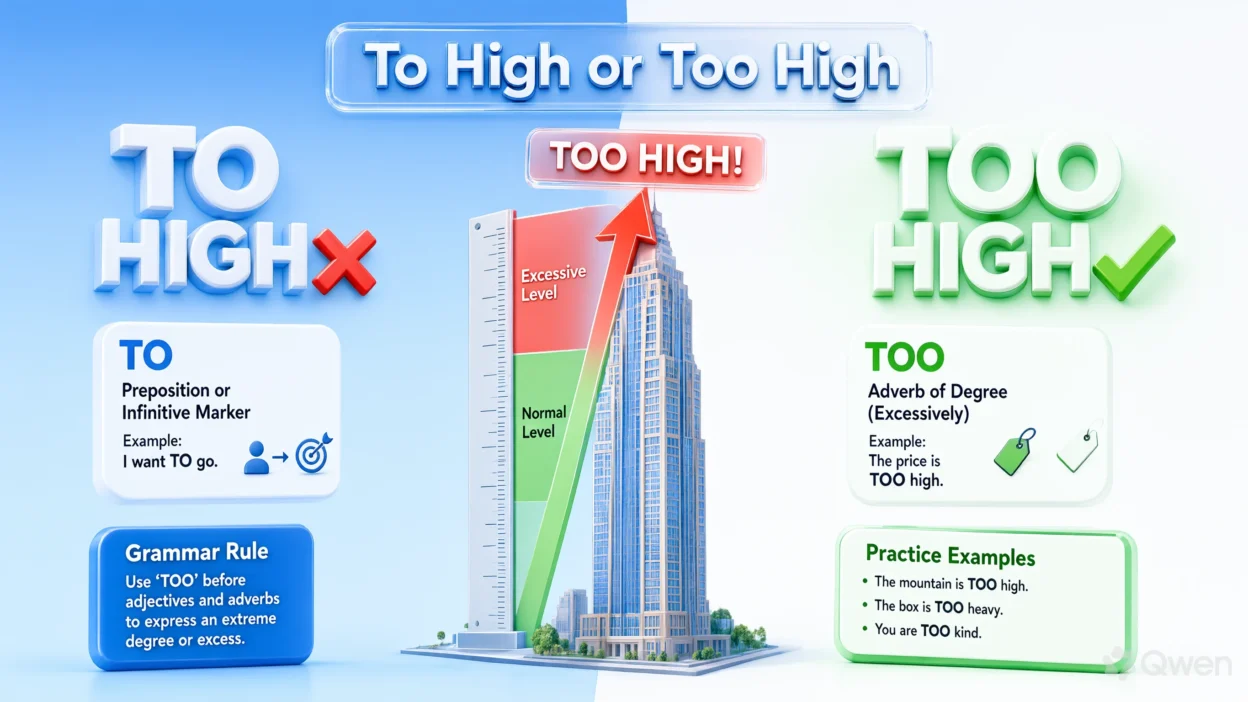
Have you ever wondered whether to write to high or too high? These two phrases look almost identical, but only one is correct when you want to describe something that exceeds a normal, expected, or comfortable height, level, or amount. Choosing the wrong word can make your writing confusing, especially when learning English grammar.
The correct phrase is too high when something is higher than it should be, more than expected, or above an acceptable limit. For example, The price is too high means the price is more expensive than someone can afford or is willing to pay.
On the other hand, to is a preposition commonly used to show direction, movement, purpose, or connection. It does not normally describe excessive height. In this guide, you will learn the difference between to high and too high, discover practical examples, and understand how to avoid this common spelling mistake.
Quick Answer: To High or Too High?
Too high is correct when describing something that is excessively high, elevated, expensive, or above an acceptable level. The word too means more than necessary or desirable. For example, The temperature is too high. The phrase to high is generally incorrect when expressing this meaning because to is a preposition, not an adverb of degree.
Why Do People Confuse To High and Too High?
People often confuse to and too because both words sound exactly alike in everyday English. This makes them easy to mix up when writing emails, messages, school assignments, and social media posts.
However, their grammatical functions are different.
- To: A preposition that expresses direction, destination, purpose, or a relationship.
- Too: An adverb that means excessively or more than necessary. It can also mean additionally or also.
The confusion usually happens when someone writes quickly without checking the meaning of the sentence.
For example:
- Incorrect: The building is to high.
- Correct: The building is too high.
The second sentence correctly explains that the building exceeds the expected or desired height.
What Does Too High Mean?
Too high means that something is above the desired, acceptable, comfortable, or normal level.
It can describe physical height, prices, temperatures, sounds, expectations, risks, and other measurable or abstract levels.
Examples:
- The rent is too high for my budget.
- The ceiling is too high to reach.
- The temperature is too high today.
- Your expectations are too high.
- The noise level is too high.
In each example, too communicates excess. It tells readers that something has gone beyond a suitable or acceptable point.
How Is Too Used in English?
Too is commonly used before adjectives and adverbs to express an excessive degree.
Examples:
- Too expensive
- Too difficult
- Too tall
- Too cold
- Too slowly
- Too high
It can also mean additionally or also when placed at the end of a sentence.
Example: I want to come too.
What Does To Mean in English?
To is a preposition or part of an infinitive verb form. It has several grammatical uses, including showing direction, destination, purpose, and relationships.
Unlike too, it does not mean excessively.
Examples:
- I am going to school.
- She gave the book to her brother.
- We walked to the park.
- I want to learn English.
- He likes to read books.
Notice that to connects words and helps explain where someone is going or what action they intend to perform.
Can To Be Used Before High?
Yes! The word to can appear before high when the sentence structure requires it, but it cannot replace too in the expression meaning excessively high.
For example:
- We climbed to high ground.
- The plane continued to fly higher.
- The temperature began to rise to a high level.
Here, to performs its normal grammatical function.
To High vs Too High: Comparison Table
| Feature | To High | Too High |
| Main word | To | Too |
| Grammar | Preposition or infinitive marker | Adverb |
| Meaning | Direction or grammatical connection | Excessively high |
| Correct expression for excessive height? | No | Yes |
| Example | To reach high places | The price is too high |
| Common usage | Depends on sentence structure | Describes excessive levels |
Remember: If you want to say something is higher than acceptable or necessary, use too high.
When Should You Use Each?
Understanding the context makes choosing the correct word much easier.
When to Use Too High
Use too high when something exceeds a suitable, expected, or acceptable level.
Examples:
- The cost is too high.
- The shelf is too high for me.
- The temperature is too high for comfort.
- The volume is too high.
- The mountain is too high to climb easily.
In these sentences, too describes an excessive degree.
When to Use To Before High
Use to when it introduces a destination, direction, infinitive, or grammatical relationship.
Examples:
- We drove to a high mountain.
- She wants to reach high places.
- The road leads to high ground.
- They moved to a higher location.
Here, to is not describing excess. It connects different parts of the sentence.
15 Examples of To High and Too High in Sentences
These examples will help you understand how to use both words naturally.
Correct Examples Using Too High
- The price of this laptop is too high for me.
- The basketball hoop is too high for the little child.
- The temperature in this room is too high.
- Your expectations might be too high.
- The rent has become too high in this area.
- The sound from the speakers is too high.
- The airplane is flying too high above the clouds.
- The water level is too high after the heavy rain.
- That shelf is too high for me to reach.
- The risk of failure is too high.
- The electricity bill is too high this month.
- The mountain is too high for inexperienced climbers.
Correct Examples Using To
- We traveled to a high mountain village.
- She wants to climb to high ground.
- The path leads to a high platform.
These examples show that to high can appear as part of a grammatically correct sentence, but it does not mean excessively high.
Common Mistakes to Avoid
Even experienced English writers sometimes confuse to and too. Here are some common mistakes and their corrections.
| Incorrect Sentence | Correct Sentence |
| The price is to high. | The price is too high. |
| This wall is to high. | This wall is too high. |
| The temperature is to high. | The temperature is too high. |
| Your expectations are to high. | Your expectations are too high. |
| The volume is to high. | The volume is too high. |
Why are these mistakes incorrect?
In every incorrect example, the writer wants to describe something excessive. Therefore, too is the appropriate word.
Another common mistake is using too when you actually need to.
Incorrect: I want too learn English.
Correct: I want to learn English.
The correct choice depends on the meaning and grammatical structure of the sentence.
Memory Trick: How to Remember Too High
Here is a simple trick to remember the difference between these words.
Too has an extra O, and that extra O can remind you of extra or excessive.
- Too high: More height or level than necessary.
- To high: Not correct when expressing excessive height.
- To a high place: Correct when talking about direction or destination.
Try remembering this example:
The price is too high, so I do not want to buy it.
If you can replace too with excessively, then too is probably the correct choice.
American vs British English: To High or Too High
There is no spelling difference between American and British English when using too high.
Both varieties use the same expression and follow the same grammatical rules.
| Meaning | American English | British English |
| Excessive height | Too high | Too high |
| Excessive price | Too expensive / Too high | Too expensive / Too high |
| Direction | To a high place | To a high place |
| Excessive temperature | Too high | Too high |
For example:
- American English: The gas prices are too high.
- British English: The petrol prices are too high.
The vocabulary may differ slightly, but the use of to and too remains the same.
Similar Words and Expressions
If you want to improve your vocabulary, learning alternative expressions for too high can make your writing more interesting.
Here are some useful alternatives:
- Excessively high: Higher than an acceptable level.
- Overly high: Higher than necessary or desirable.
- Extremely high: Very high in degree or amount.
- Unreasonably high: Higher than what seems fair.
- Above average: Higher than the usual level.
- Elevated: Raised or positioned higher.
- Sky-high: Extremely high, often used informally.
- Outrageously high: Extremely high in an unreasonable way.
Examples:
- The hotel charges are unreasonably high.
- The temperature is extremely high today.
- The prices have become sky-high.
- The building has an elevated entrance.
Choose the expression that best communicates your intended meaning.
Final Verdict: To High or Too High?
The correct choice depends on what you want to express.
- Use too high when something exceeds an acceptable, comfortable, or expected level.
- Use to when showing direction, destination, purpose, or introducing an infinitive verb.
- Do not write to high when you mean excessively high.
For example, The price is too high is correct because too describes an excessive price.
FAQs:
1. Is it to high or too high?
Too high is correct when describing something that exceeds an acceptable or expected level. For example, The building is too high. To high is incorrect when used with this intended meaning.
2. What does too high mean?
Too high means higher than necessary, acceptable, comfortable, or desirable. It can describe physical height, prices, temperatures, sound levels, risks, and expectations.
3. Why is too high correct?
Too is an adverb that expresses an excessive degree. High is an adjective describing height or level. Together, they communicate that something exceeds a suitable limit.
4. Can I ever use to high in a sentence?
Yes, those words can appear next to each other in certain sentence structures. For example, We traveled to high ground. However, to high cannot replace too high when describing excess.
5. Is too high one word or two words?
Too high is written as two separate words. Too is the adverb, and high is the adjective. They work together to describe an excessive level or height.
6. What is the difference between too high and very high?
Too high suggests that something exceeds a desirable or acceptable level. Very high simply emphasizes a high degree without necessarily suggesting that it is excessive.
Example:
- The price is very high. (It costs a lot.)
- The price is too high. (It costs more than I can accept or afford.)
7. Is too high grammatically correct in American and British English?
Yes. Too high is grammatically correct in both American and British English. There is no difference in spelling or meaning between the two varieties.
Remember This
- Too high = Excessively high.
- To = Direction, destination, purpose, or infinitive marker.
- Very high = Extremely high, without necessarily suggesting excess.
- Too high works in both American and British English.
Always use too high when you mean something is higher than it should be.
Conclusion
Understanding the difference between to high and too high is simple once you remember what each word does. Too describes something excessive, while to shows direction, purpose, or a grammatical connection. Although they sound alike, their meanings and uses are completely different.
The next time you write about an expensive price, an uncomfortable temperature, or an object that is difficult to reach, remember to use too high. Keep practicing with real-life examples, and you will make this common English grammar mistake much less often.

I’m Ethan Carter, Administrator at Instahuts. I manage content quality, improve user experience, and ensure every Instagram bio resource is accurate, creative, and helpful for users building standout online profiles.