Understanding the difference between an analogy and a metaphor can make your writing, reading, and everyday communication much easier. Both are useful ways to explain ideas by connecting one thing to another, but they do not work in exactly the same way.
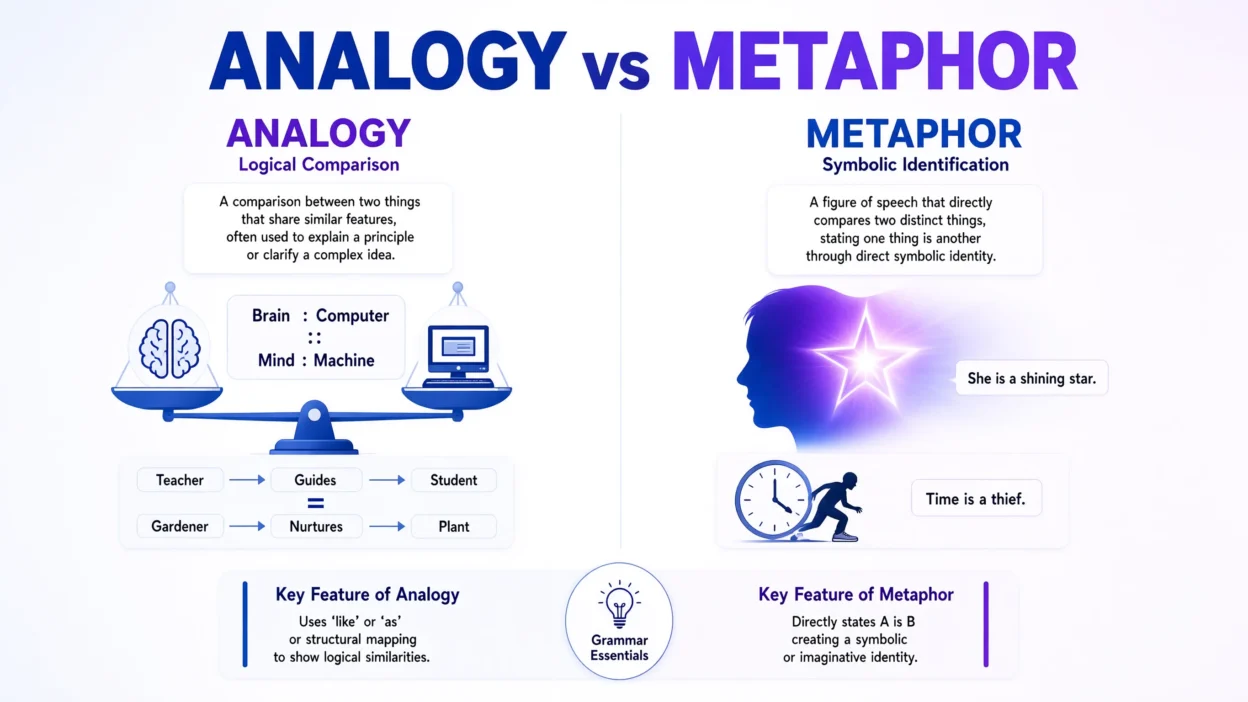
An analogy explains how two things are similar by comparing their relationships, functions, or characteristics. A metaphor describes one thing as another to create a meaningful or imaginative connection. For example, “The brain is like a computer” is an analogy because it explains how the brain works through comparison.
On the other hand, “Time is a thief” is a metaphor because it describes time as something that steals moments from our lives. Although these literary devices are closely related, knowing when to use each one will help you express your thoughts more clearly and creatively.
Quick Answer: Analogy vs Metaphor
An analogy is a comparison that explains an idea by showing how two things are alike, often through their relationships or functions. A metaphor directly describes one thing as another to create a vivid image or deeper meaning. In short, an analogy explains similarities, while a metaphor creates an imaginative connection.
Why Do People Confuse Analogy and Metaphor?
People often confuse analogy and metaphor because both literary devices compare two different things to communicate an idea.
They help readers understand unfamiliar concepts through familiar examples. However, their purposes are slightly different.
Here are three main reasons for the confusion:
- Similar purpose: Both make explanations easier to understand.
- Comparisons: Both connect two different things through shared characteristics.
- Creative language: Both are commonly used in stories, conversations, speeches, and writing.
The biggest difference is that an analogy focuses on explaining a similarity, while a metaphor creates a direct comparison to express an idea.
What Is an Analogy?
An analogy is a comparison between two different things that shows how their characteristics, functions, or relationships are similar.
Writers, teachers, and speakers use analogies to explain complicated ideas in simple language. An analogy helps readers understand something unfamiliar by connecting it to something they already know.
For example:
- Learning a language is like building a house. You need a strong foundation before adding more details.
- The heart works like a pump because it moves blood throughout the body.
- A teacher is like a guide who helps students find the right direction.
In each example, the comparison explains how two things are similar.
Examples of Analogy in Everyday English
- A classroom is like a garden: Students grow through knowledge and care.
- The internet is like a library: Both provide access to information.
- A good friendship is like a strong bridge: It connects people and helps them through difficult times.
- The human body is like a machine: Different parts work together to keep it functioning.
- Managing money is like managing time: Both require planning and wise decisions.
When Should You Use an Analogy?
Use an analogy when you want to:
- Explain a difficult concept.
- Make an unfamiliar idea easier to understand.
- Compare how two systems work.
- Help students learn new information.
- Make an argument clearer and more convincing.
An analogy is especially useful in educational writing, presentations, discussions, and explanatory articles.
What Is a Metaphor?
A metaphor is a figure of speech that describes one thing as another to suggest a similarity without using words such as “like” or “as.”
Metaphors make language more expressive, emotional, and imaginative. They allow writers to communicate feelings and ideas in a memorable way.
For example:
- Time is a thief.
- Her voice is music to my ears.
- The world is a stage.
- He has a heart of stone.
- Knowledge is power.
These sentences do not mean that time is literally a thief or that the world is actually a stage. Instead, they create meaningful comparisons.
Examples of Metaphor in Everyday English
- Life is a journey: Life involves experiences, challenges, and changes.
- He is a shining star: He is talented or successful.
- Her words were daggers: Her words were deeply hurtful.
- The classroom was a zoo: The classroom was extremely noisy and chaotic.
- My brother is a walking dictionary: He knows a lot of information.
When Should You Use a Metaphor?
Use a metaphor when you want to:
- Make your writing more creative.
- Express emotions indirectly.
- Create strong mental pictures.
- Make stories more interesting.
- Communicate abstract ideas in memorable language.
Metaphors are particularly common in poetry, fiction, songs, speeches, and everyday conversations.
Analogy vs Metaphor: Comparison Table
Although analogy and metaphor are related, they have different purposes and structures.
| Feature | Analogy | Metaphor |
| Meaning | Explains similarities | Describes one thing as another |
| Main purpose | To explain an idea | To create an image or meaning |
| Structure | Often uses extended comparisons | Uses direct comparisons |
| Language | Usually explanatory | Often imaginative |
| Common words | Like, as, similar to | Is, are, was |
| Length | Can be detailed | Often short |
| Usage | Teaching and explanations | Creative and descriptive writing |
| Example | The brain works like a computer. | The brain is a computer. |
Key difference: An analogy explains how two things are similar, while a metaphor describes one thing in terms of another. A metaphor can also be part of a larger analogy.
When to Use Analogy vs Metaphor
Choosing between these two literary devices depends on what you want to communicate.
Use an Analogy for Explanation
Choose an analogy when your main goal is to help someone understand an unfamiliar subject.
Examples:
- Explaining the human heart by comparing it to a pump.
- Explaining the internet by comparing it to a library.
- Explaining teamwork by comparing it to an orchestra.
An analogy is helpful when readers need a logical connection between two ideas.
Use a Metaphor for Creative Expression
Choose a metaphor when you want your language to sound more expressive or imaginative.
Examples:
- Her smile was sunshine.
- His mind is a treasure chest.
- The city was a jungle.
A metaphor helps readers imagine an idea or feel an emotion without a lengthy explanation.
Can You Use Both Together?
Yes! An analogy can include metaphors to make an explanation more memorable.
For example:
“Life is a journey. Every challenge is a mountain, every opportunity is a new road, and every decision takes us somewhere.”
Here, “Life is a journey” is a metaphor, while the extended comparison between life experiences and traveling is an analogy.
12 Examples of Analogy vs Metaphor
The easiest way to understand the difference is to examine practical examples.
| Analogy | Metaphor |
| The brain works like a computer. | The brain is a computer. |
| Learning is like planting seeds. | Learning is a seed. |
| The heart works like a pump. | The heart is an engine. |
| Life is like a long journey. | Life is a journey. |
| A teacher is like a compass. | A teacher is a compass. |
| Friendship is like a strong bridge. | Friendship is a bridge. |
| The internet is like a library. | The internet is a library. |
| Anger spreads like wildfire. | Anger is a wildfire. |
| A team works like a machine. | A team is a machine. |
| Time passes like a flowing river. | Time is a river. |
| Knowledge grows like a tree. | Knowledge is a tree. |
| A busy classroom is like a beehive. | The classroom is a beehive. |
Notice that the analogy often explains the relationship between two things, while the metaphor presents the comparison directly.
Common Mistakes When Using Analogy and Metaphor
Even experienced writers sometimes mix up these two terms. Understanding the following mistakes can help you use them correctly.
1. Thinking Every Comparison Is a Metaphor
Not every comparison is a metaphor. An analogy may explain a relationship in detail rather than simply describing one thing as another.
2. Confusing Similes With Metaphors
A simile uses “like” or “as” to compare two things.
- Simile: Her eyes shine like stars.
- Metaphor: Her eyes are stars.
Both are figures of speech, but their structures are different.
3. Assuming Analogies Must Be Short
An analogy can be a single sentence or several paragraphs long. Extended analogies are commonly used in teaching and storytelling.
4. Taking Metaphors Literally
Metaphors are usually not meant to be understood literally.
For example, “He has a heart of stone” means that someone is emotionally unkind or insensitive.
5. Using an Unclear Comparison
A good analogy or metaphor should make the intended meaning easier to understand. Avoid comparisons that confuse readers instead of helping them.
Easy Memory Trick to Remember the Difference
Here is a simple way to remember analogy and metaphor:
- Analogy = Explanation: Think of an analogy as a tool for explaining how things are similar.
- Metaphor = Imagination: Think of a metaphor as a creative way to describe something.
Remember these two examples:
- Analogy: A teacher is like a lighthouse because both guide others.
- Metaphor: A teacher is a lighthouse.
The first explains a similarity, while the second creates an imaginative description.
Quick tip: If the comparison explains how something works, it is probably an analogy. If it describes something as something else, it is probably a metaphor.
Analogy vs Metaphor in American and British English
There is no meaningful difference between analogy and metaphor in American and British English.
Both varieties of English use these literary devices in the same general way.
| Feature | American English | British English |
| Analogy | Same meaning | Same meaning |
| Metaphor | Same meaning | Same meaning |
| Grammar | Same general usage | Same general usage |
| Spelling | Analogy, metaphor | Analogy, metaphor |
| Literary purpose | Explanation and expression | Explanation and expression |
For example:
- American English: “Life is a journey.”
- British English: “Life is a journey.”
Both sentences use the same metaphor and have the same meaning.
Similar Words Related to Analogy and Metaphor
Several literary terms are connected to analogy and metaphor. Understanding them can help you become a better reader and writer.
| Word | Meaning | Example |
| Simile | Compares using like or as | She is as brave as a lion. |
| Comparison | Shows similarities or differences | Summer is warmer than winter. |
| Symbolism | Uses something to represent an idea | A dove represents peace. |
| Personification | Gives human qualities to nonhuman things | The wind whispered. |
| Allegory | A story with a deeper symbolic meaning | A story representing political struggles. |
| Hyperbole | An intentional exaggeration | I’ve told you a million times. |
| Metonymy | Uses a related term to represent something | The crown represents the monarchy. |
| Imagery | Language that creates sensory pictures | The golden sunlight filled the room. |
These terms are useful in literature, creative writing, poetry, and everyday communication.
Final Verdict: Analogy vs Metaphor
Both analogy and metaphor are powerful ways to connect different ideas, but they serve different purposes.
- Analogy explains how two things are similar, often to make a difficult idea easier to understand.
- Metaphor describes one thing as another to create a vivid image or deeper meaning.
For example, “The heart works like a pump” is an analogy because it explains the heart’s function. “The heart is an engine” is a metaphor because it creates a direct imaginative comparison.
Remember that a metaphor can also be used within an analogy. The two terms are related, but they are not interchangeable.
FAQs:
1. What is the main difference between analogy and metaphor?
An analogy explains how two different things are similar, often through their functions or relationships. A metaphor directly describes one thing as another to create an imaginative comparison. Analogies mainly explain, while metaphors mainly express.
2. Is an analogy a type of metaphor?
No. An analogy and a metaphor are different literary devices. However, a metaphor can be part of an analogy. An analogy is generally broader because it can explain similarities through detailed comparisons.
3. What is an example of an analogy?
“The human heart works like a pump because it moves blood throughout the body.”
This is an analogy because it compares the heart with a pump to explain how both perform a similar function.
4. What is an example of a metaphor?
“Time is a thief.”
This is a metaphor because it describes time as a thief to suggest that time takes away valuable moments from our lives.
5. Is “Life is a journey” an analogy or a metaphor?
“Life is a journey” is primarily a metaphor because it describes life as a journey. However, it can become part of an analogy when the writer explains how life’s challenges, decisions, and experiences resemble traveling.
6. What is the difference between a simile, analogy, and metaphor?
A simile compares two things using “like” or “as.” A metaphor directly describes one thing as another. An analogy explains similarities between two things, often in greater detail.
Examples:
- Simile: He is as strong as a lion.
- Metaphor: He is a lion.
- Analogy: A strong leader is like a lion because both show courage and confidence.
7. Can an analogy contain a metaphor?
Yes. An analogy can contain one or more metaphors. For example, “Life is a journey, and every difficult experience is a mountain we must climb” uses metaphorical language within an extended analogy about life.
Remember This
- Analogy explains similarities between two things.
- Metaphor describes one thing as another.
- Simile uses “like” or “as” to make comparisons.
- Analogies are useful for teaching and explaining.
- Metaphors are useful for creative and descriptive writing.
- A metaphor can be part of a larger analogy.
Conclusion
Understanding analogy vs metaphor is important for anyone who wants to improve their English, writing, or communication skills. Although both literary devices use comparisons, they have different purposes. An analogy makes an idea easier to understand by explaining similarities, while a metaphor makes language more expressive by describing one thing as another.
The next time you read a book, write a story, or explain an idea, pay attention to how comparisons are used. Choose an analogy when you want to explain something clearly and a metaphor when you want to create a memorable image. With regular practice, you will be able to recognize and use both confidently.

I am Ryan Mitchell, an author at Instahuts passionate about creating engaging Instagram bio ideas. I enjoy helping readers express their personality through creative, stylish, and unique bios that make every profile stand out.