Have you ever wondered if to use master or mister when addressing a boy or a man? These two words may sound similar, but they have different meanings and uses. Understanding the difference between master and mister can help you choose the correct word in writing, formal communication, and everyday conversations.
The word master traditionally refers to a young boy when used as a title, but it can also describe someone with great skill, authority, or control over something. On the other hand, mister is a respectful title used before an adult man’s surname or full name.
It is commonly abbreviated as Mr. Both words have interesting historical backgrounds, which sometimes make them confusing for English learners. In this guide, you will learn what each word means, how to use it correctly, and how to remember the difference through simple explanations and practical examples.
Quick Answer: Master vs Mister
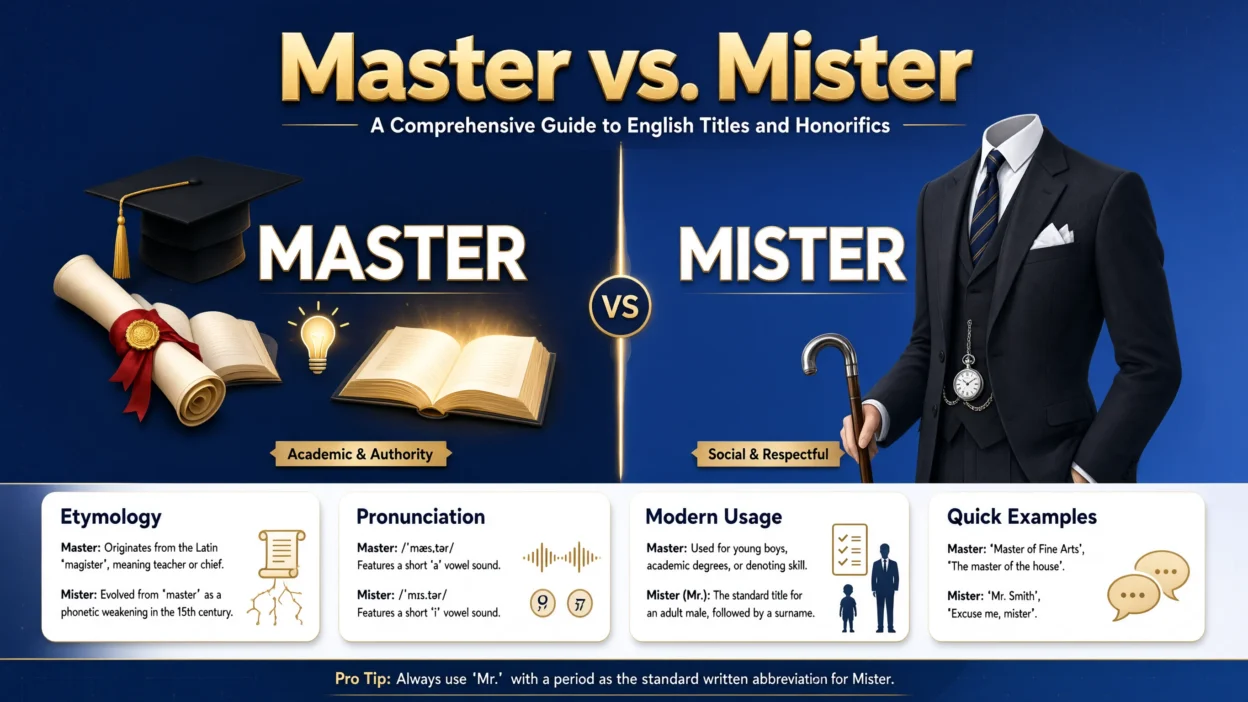
Master and mister are different English words. Master traditionally serves as a title for a young boy and also means someone highly skilled or in control. Mister is a polite title for an adult man, usually written as Mr. before his name. The correct choice depends on the meaning and context.
Why Do People Confuse Master and Mister?
People often confuse these words because they have similar sounds and are both traditionally used as titles before people’s names.
However, their meanings are different:
- Master: Traditionally a title for a boy or a word describing someone with great skill, knowledge, or authority.
- Mister: A respectful title used when addressing or referring to an adult man.
Another reason for confusion is that both words have historical connections with respect and social status. However, modern English uses them in different situations.
Remember that master and mister are not interchangeable. Choosing the wrong one can change the meaning or make a sentence sound unusual.
What Does Master Mean?
Master is a noun, verb, and title with several meanings. Traditionally, it was used as a respectful title for a young boy, particularly before his first and last name.
For example:
- Master James Wilson is waiting outside.
- The invitation was addressed to Master Daniel Brown.
Today, using Master as a title for boys is relatively uncommon in everyday English. It may still appear in traditional correspondence, formal invitations, or certain official contexts.
The word also has other common meanings.
1. Master as Someone Highly Skilled
A master can be someone who has excellent knowledge or skill in a particular subject or activity.
Examples:
- She is a master of classical music.
- He became a master chef after years of experience.
2. Master as Someone in Control
The word can describe someone who has authority or control over something.
Example:
- The dog obeys its master.
3. Master as a Verb
As a verb, master means to learn something extremely well or become highly skilled at it.
Examples:
- I want to master the English language.
- She mastered the art of photography.
Simple definition: Master can refer to a traditional title for a boy, a highly skilled person, or someone who has control or authority.
What Does Mister Mean?
Mister is a polite and respectful title used before an adult man’s surname or full name. Its standard written abbreviation is Mr.
It is commonly used in formal conversations, business communication, letters, and everyday situations.
Examples:
- Mister John is our new teacher.
- Mr. Smith works at the bank.
- Good morning, Mr. Brown.
The word mister is generally used for adult men regardless of whether they are married or unmarried.
Unlike master, mister does not describe someone who has special skills, authority, or control over something.
How Is Mister Abbreviated?
The standard abbreviation of mister is Mr.
Examples:
- Mr. David
- Mr. Johnson
- Mr. William Brown
In American English, the abbreviation is commonly written with a period (Mr.). In British English, it is often written without a period (Mr), although both forms are understood.
Simple definition: Mister is a respectful title used before an adult man’s name or surname.
Master vs Mister: Comparison Table
| Feature | Master | Mister |
| Meaning | Traditional title for a boy; also means an expert or person in control | Respectful title for an adult man |
| Abbreviation | No universally standard title abbreviation | Mr. |
| Usage | Traditional, specialized, or skill-related contexts | Everyday and formal communication |
| Gender | Traditionally used as a male title | Used for men |
| Age | Traditionally associated with boys as a title | Generally associated with adult men |
| Example | Master Daniel | Mr. Daniel |
| Word type | Noun, verb, and title | Noun and title |
The main difference is that master traditionally refers to a boy when used as a personal title, whereas mister is the standard respectful title for an adult man.
When Should You Use Master or Mister?
Knowing when to use each word makes your English clearer and more natural.
When to Use Master
Use master in these situations:
- As a traditional title for a boy: Master William is invited to the ceremony.
- For someone with exceptional skills: She is a master of painting.
- For someone who controls something: The servant followed his master’s instructions.
- As a verb meaning to learn completely: He wants to master mathematics.
- In academic contexts: She completed a master’s degree in English.
When to Use Mister
Use mister in these situations:
- When respectfully addressing an adult man: Good afternoon, Mister.
- Before a man’s surname: Mr. Wilson is our manager.
- In formal letters: Dear Mr. Johnson.
- In professional communication: Please contact Mr. Smith.
- In everyday conversation: Excuse me, Mister, you dropped your wallet.
Choose master when you mean the traditional boy’s title or one of its other meanings. Choose mister when you need a polite title for an adult man.
15 Examples of Master vs Mister in Sentences
The following examples will help you understand how both words work in everyday English.
Examples Using Master
- Master William was invited to his friend’s birthday party.
- The letter was addressed to Master James Brown.
- She is a master of creative writing.
- He wants to master the Spanish language.
- The dog followed its master into the garden.
- My brother is a master at solving difficult puzzles.
- It took her several years to master the piano.
- The young boy was traditionally addressed as Master Thomas.
Examples Using Mister
- Mr. Smith is our new English teacher.
- Good morning, Mister.
- Mr. Johnson lives next door to us.
- I received an email from Mr. Brown.
- Excuse me, Mister, may I ask you a question?
- Mr. David will attend the meeting tomorrow.
- The students respectfully greeted Mr. Wilson.
These examples show that the two words have different purposes. Master has several meanings, while mister is primarily used as a respectful title for men.
Common Mistakes When Using Master and Mister
English learners sometimes use these words incorrectly because they sound similar. Here are some mistakes to avoid.
Mistake 1: Using Master Instead of Mister
Incorrect: Master John is our new manager.
Correct: Mr. John is our new manager.
Why? When addressing an adult man respectfully, use Mr. or Mister.
Mistake 2: Using Mister as a Skill-Related Word
Incorrect: She is a mister of mathematics.
Correct: She is a master of mathematics.
Why? Master describes someone with exceptional knowledge or skill.
Mistake 3: Thinking Mister Is Only for Married Men
Incorrect: Mister is used only for married men.
Correct: Mister can be used for adult men regardless of marital status.
Why? Mr. does not indicate whether a man is married or unmarried.
Mistake 4: Assuming Master Is Always a Title for Boys
Incorrect: Master always refers to a young boy.
Correct: Master has several meanings, including an expert, a person in control, and the act of learning something completely.
Why? Its meaning depends on how it is used in a sentence.
Mistake 5: Writing the Wrong Abbreviation
Incorrect: Ms. John Smith (when intending to use the male title).
Correct: Mr. John Smith.
Why? Mr. is the abbreviation of mister, while Ms. is a different title.
Easy Memory Trick to Remember Master vs Mister
Here is a simple way to remember the difference:
- Master = Boy, skill, or control.
- Mister = Adult man and respect.
You can also remember the abbreviation:
- Master = Master (usually written in full as a traditional title).
- Mister = Mr.
Quick memory tip: If you are respectfully addressing an adult man, use Mr. If you are talking about a traditional title for a boy or someone highly skilled, use master.
Master vs Mister in American and British English
The meanings of master and mister are generally the same in American and British English. However, there are some differences in spelling conventions and traditional usage.
American English
In American English:
- Mr. is the common abbreviation of mister.
- Master is rarely used as a personal title for boys in everyday communication.
- Master is commonly used to describe expertise, skill, or control.
Examples:
- Mr. Johnson is my neighbor.
- She is a master of design.
British English
In British English:
- Mr is commonly written without a period.
- Master has traditionally been used as a title for boys in formal correspondence.
- Master is also used to describe expertise and control.
Examples:
- Mr Smith is our new headteacher.
- Master William has received an invitation.
Important: The main difference between American and British English is the punctuation convention for Mr. The meanings of the two words remain essentially the same.
Similar Words Related to Master and Mister
Several English words and titles are related to master and mister. Understanding them can help expand your vocabulary.
| Word | Meaning | Example |
| Mr. | Abbreviation of mister | Mr. Brown is here. |
| Master | A skilled person or traditional title for a boy | He is a master chef. |
| Sir | A respectful way to address a man | Thank you, sir. |
| Gentleman | A polite or well-mannered man | He is a true gentleman. |
| Ms. | A title for a woman regardless of marital status | Ms. Taylor is our teacher. |
| Mrs. | A title traditionally used for a married woman | Mrs. Smith is a doctor. |
| Miss | A title traditionally used for an unmarried woman or girl | Miss Johnson is here. |
These words may all appear as titles or forms of respectful address, but they have different meanings and uses.
Final Verdict: Master or Mister?
The correct word depends on what you want to express.
- Use master when referring to a traditional title for a young boy, someone highly skilled, or someone who has control over something.
- Use mister when respectfully addressing or referring to an adult man. Its standard abbreviation is Mr.
For example:
- Master James received a birthday invitation.
- Mr. James is our new school principal.
- She is a master of English grammar.
Although these words sound similar, their meanings and grammatical uses are different. Understanding the context will help you choose the correct word every time.
FAQs:
1. What is the main difference between master and mister?
Master has several meanings, including a traditional title for a boy, an expert, or someone with control. Mister is a respectful title used before an adult man’s name or surname. Its abbreviation is Mr.
2. Is master used for boys or men?
Traditionally, Master was used as a title for boys, especially in formal correspondence. However, the word can also describe an adult who has exceptional knowledge or skill in a particular field.
3. Is mister the same as Mr.?
Yes. Mister is the full word, while Mr. is its standard written abbreviation. Both are used as respectful titles for adult men.
4. Can I use master instead of mister?
No, not when addressing an adult man with a respectful title. Use Mr. or Mister instead. Master has different meanings and is not a direct replacement for mister.
5. Is master still used as a title for boys?
Yes, but it is relatively uncommon in modern everyday English. It may still appear in traditional invitations, formal correspondence, and certain official contexts.
6. What is the female equivalent of mister?
There is no single exact female equivalent in every context. Common titles include Miss, Ms., and Mrs. Ms. is often preferred when a woman’s marital status is unknown or irrelevant.
7. Is master a noun or a verb?
Master can be both a noun and a verb. As a noun, it can mean an expert or someone with control. As a verb, it means to learn something thoroughly or become highly skilled at it.
Remember This
- Master = A traditional title for a boy, an expert, or someone in control.
- Mister = A respectful title for an adult man.
- Mr. = The standard abbreviation of mister.
- Master and mister are not interchangeable.
- Context determines which word is correct.
Conclusion
Understanding the difference between master and mister is simple once you know their meanings. Master can describe a highly skilled person, someone with authority, or traditionally serve as a title for a young boy. Mister, on the other hand, is a polite title used for adult men and is commonly abbreviated as Mr.
Whenever you are addressing an adult man respectfully, choose mister or Mr. When discussing expertise, control, or the traditional title for a boy, use master. Remembering these simple rules will help you avoid common mistakes and use both words confidently in your writing and everyday conversations.

I am Daniel Brooks, a passionate writer at Instahuts who enjoys creating engaging Instagram bio ideas. I help readers express their personalities with creative, stylish, and meaningful bios that make every profile stand out.