Have you ever wondered if to write anyone or any one? These two expressions look almost identical, sound the same, and are often confused in everyday writing. However, they have different meanings and grammatical uses. Choosing the correct form depends on what you want to say.
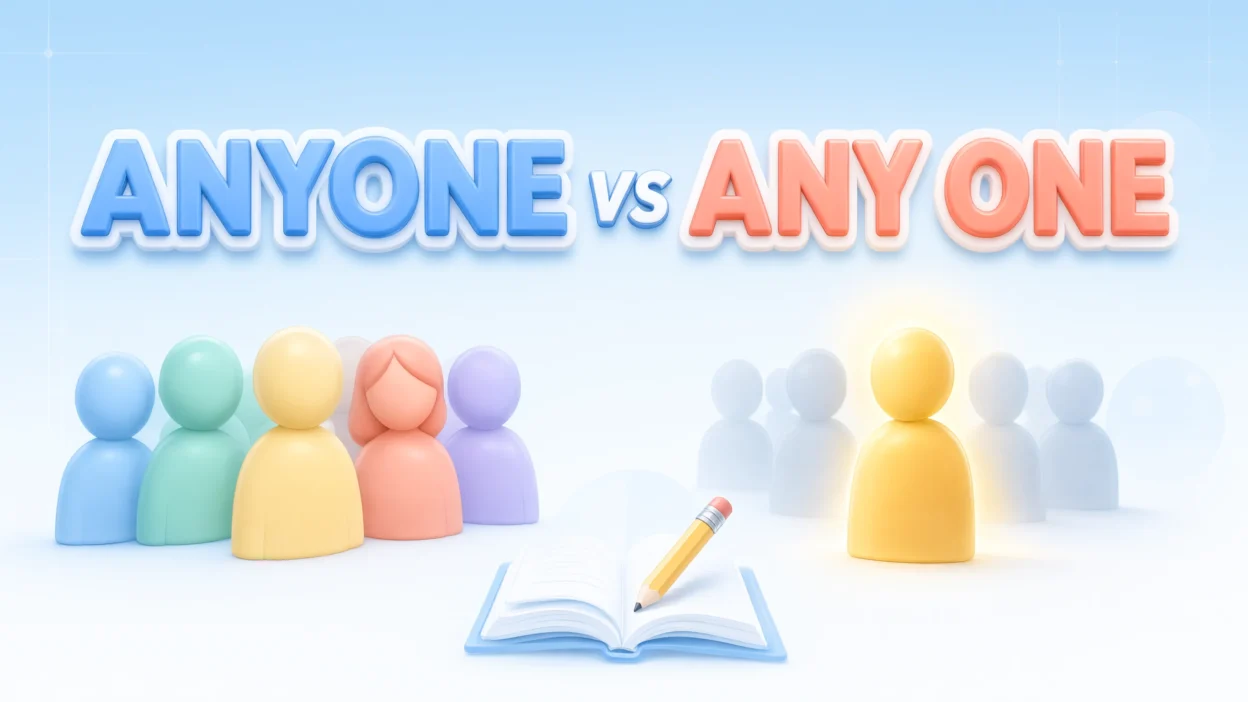
The good news is that the difference is easy to understand once you know how each expression works. Anyone is a pronoun that means any person, while any one refers to a single person or thing from a particular group.
For example, you can say, “Anyone can join the competition,” but “You can choose any one of these books.” Both forms are correct, but they are not always interchangeable. In this guide, you’ll learn their meanings, grammatical differences, examples, common mistakes, and simple tricks to remember when to use each one.
Quick Answer: Anyone or Any One?
Anyone is one word and means any person. Any one is two words and means one individual person or thing from a specific group. Use anyone when talking about people generally, and use any one when emphasizing a single choice from several possibilities. Both spellings are correct in different contexts.
Why Do People Confuse Anyone and Any One?
People often confuse these expressions because they:
- Sound exactly the same when spoken.
- Have nearly identical spelling.
- Both contain the words “any” and “one” in meaning or form.
- Can appear in sentences about people.
- Are sometimes used in similar conversational situations.
The main difference is their grammatical function.
- Anyone: An indefinite pronoun referring to any person.
- Any one: A combination of a determiner and the word “one,” referring to a single individual or item.
Understanding this distinction makes it easier to choose the right expression.
What Does Anyone Mean?
Anyone is an indefinite pronoun meaning any person or anybody. It refers to people without identifying a particular individual.
It is commonly used in questions, negative sentences, and general statements.
Examples of Anyone in Sentences
- Anyone can learn a new language with practice.
- Does anyone know the correct answer?
- I don’t think anyone is at home.
- Anyone interested in the event can register.
- She didn’t tell anyone about her plans.
- Can anyone help me with this question?
When Should You Use Anyone?
Use anyone when:
- Talking about people in general.
- Referring to an unknown person.
- Asking whether somebody is available.
- Making general statements about people.
- Referring to people without choosing a specific individual.
Example: Anyone can participate in the school competition.
Here, anyone means any person who wants to participate.
What Does Any One Mean?
Any one is a two-word expression that means one individual person or thing from a group of possibilities.
The word “one” emphasizes a single person, object, choice, or item.
It is often followed by “of” and a plural noun.
Examples of Any One in Sentences
- You can choose any one of these dresses.
- Any one of the students can answer the question.
- I would be happy with any one of these options.
- You may select any one book from the shelf.
- Any one of these roads will take you to the city.
- She can invite any one of her friends.
When Should You Use Any One?
Use any one when:
- Referring to a single person from a group.
- Selecting one item from several choices.
- Emphasizing an individual object.
- Talking about one member of a particular collection.
- Explaining that one option is acceptable.
Example: You can take any one of these pens.
Here, any one means a single pen selected from the available pens.
Anyone vs Any One: Comparison Table
| Feature | Anyone | Any One |
| Spelling | One word | Two words |
| Meaning | Any person | One individual |
| Grammar | Pronoun | Determiner + pronoun |
| Refers to | People generally | One person or thing in a group |
| Common use | Questions and general statements | Choices and selections |
| Example | Anyone can participate. | Choose any one of these. |
Key difference: Anyone refers to any person, while any one emphasizes one individual person or thing from a group.
When to Use Anyone vs Any One
Choosing between these expressions becomes easier when you consider the meaning of your sentence.
1. Use Anyone When Talking About People Generally
If your sentence refers to people without specifying a particular group, use anyone.
Examples:
- Anyone can become a good writer.
- Anyone can make mistakes.
- Anyone is welcome to attend.
2. Use Any One When Choosing From a Group
If you are selecting one person or thing from several possibilities, use any one.
Examples:
- Choose any one of these colors.
- You can ask any one of the teachers.
- Take any one of these cookies.
3. Use Anyone in Questions
When asking whether a person is available or knows something, anyone is generally correct.
Examples:
- Is anyone coming to the party?
- Has anyone seen my phone?
- Does anyone understand this lesson?
4. Use Any One to Emphasize a Single Choice
When the number or individuality of your selection matters, use any one.
Examples:
- Any one of these answers could be correct.
- You may select any one of the three packages.
- Any one of these players could win.
15 Examples of Anyone and Any One in Sentences
Here are practical examples to help you understand how both expressions work in everyday English.
| Anyone | Any One |
| Anyone can join us. | Choose any one of these chairs. |
| Anyone can make a mistake. | Any one of these answers is acceptable. |
| Did anyone call me? | Ask any one of the managers. |
| Anyone can learn English. | Take any one of these books. |
| I didn’t see anyone there. | You can choose any one of the colors. |
| Anyone is welcome here. | Any one of these students can help. |
| Can anyone explain this? | Select any one of the available options. |
| Anyone can try this game. | Any one of these keys may open the door. |
More Examples in Everyday Conversations
Using anyone:
- “Is anyone sitting here?”
- “I haven’t told anyone my secret.”
- “Anyone who works hard can succeed.”
Using any one:
- “You can pick any one of my shirts.”
- “Any one of these computers will work.”
- “Choose any one of the available dates.”
These examples show that context determines which form you need.
Common Mistakes to Avoid
Even experienced English writers sometimes confuse these expressions. Here are some mistakes worth avoiding.
Mistake 1: Writing Anyone When You Mean One Item
Incorrect: You can choose anyone of these books.
Correct: You can choose any one of these books.
Why? The sentence refers to one book from a group, so any one is correct.
Mistake 2: Writing Any One When You Mean Any Person
Incorrect: Any one can learn English.
Correct: Anyone can learn English.
Why? The sentence makes a general statement about people, so anyone is the correct choice.
Mistake 3: Confusing Anyone With Everyone
Anyone means any person, while everyone means all people in a group.
Examples:
- Anyone can enter the building. (Any person may enter.)
- Everyone must enter the building. (All people must enter.)
Mistake 4: Forgetting the Word “Of”
Incorrect: Any one the students can participate.
Correct: Any one of the students can participate.
Why? When referring to one member of a particular group, the expression commonly takes “of” before the group.
Easy Memory Trick: How to Remember Anyone and Any One
Use this simple trick to remember the difference:
- Anyone = Any person. Think of a general reference to people.
- Any one = One choice. Think of selecting a single person or thing from a group.
Remember these two examples:
- Anyone can play the game.
- You can choose any one of these games.
Quick memory tip:
If you can replace the expression with “any person,” write anyone.
If you mean “one individual from a group,” write any one.
Anyone vs Any One in American and British English
There is no meaningful spelling difference between American and British English when it comes to anyone and any one.
Both varieties use the same spelling and grammatical distinction.
| Expression | American English | British English |
| Anyone | Correct | Correct |
| Any one | Correct | Correct |
Examples in both varieties:
- Anyone can apply for the position.
- You can choose any one of these options.
The choice depends on meaning and sentence structure, not regional spelling preferences.
Similar Words and Expressions
Understanding related expressions can help you improve your English vocabulary and avoid similar mistakes.
| Word or Expression | Meaning | Example |
| Anybody | Any person | Anybody can join. |
| Somebody | An unspecified person | Somebody is waiting. |
| Someone | A particular but unnamed person | Someone called you. |
| Nobody | No person | Nobody was there. |
| Everybody | All people | Everybody enjoyed the show. |
| Everyone | Every person | Everyone is ready. |
| Each one | Every individual separately | Each one received a gift. |
| Any one of | One individual from a group | Any one of these will work. |
Remember: Anyone and anybody are generally interchangeable, while any one emphasizes a single individual or item.
Final Verdict: Anyone or Any One?
Both anyone and any one are grammatically correct, but they have different meanings.
- Use anyone when referring to any person in general.
- Use any one when referring to a single person or thing from a group.
For example:
- Anyone can become a successful writer.
- You can choose any one of these writing courses.
The easiest way to avoid mistakes is to focus on the meaning of your sentence. If you mean any person, use anyone. If you mean one individual choice, use any one.
FAQs:
1. Is anyone one word or two words?
Anyone is written as one word. It is an indefinite pronoun that means any person or anybody.
Example: Anyone can participate in the competition.
2. Is any one ever correct?
Yes, any one is completely correct when referring to one individual person or thing from a group.
Example: You can select any one of these options.
3. What is the difference between anyone and any one?
Anyone means any person, while any one means one individual person or thing from a group. The difference is mainly grammatical and depends on the context of the sentence.
4. Should I write anyone of them or any one of them?
The correct expression is any one of them when you mean one individual from a group.
Example: Any one of them can help you.
5. Is anyone the same as anybody?
Yes. Anyone and anybody generally have the same meaning and can be used interchangeably in most everyday sentences.
Example: Anyone can attend the meeting.
Example: Anybody can attend the meeting.
6. Can anyone refer to things?
No. Anyone refers to people, not objects. When referring to one object from a group, use any one.
Example: You can choose any one of these phones.
7. Is anyone’s or any one’s correct?
Both forms can be correct, but they have different uses.
– Anyone’s is the possessive form of anyone.
Example: Anyone’s opinion is welcome.
– Any one’s is possible when the possessive meaning of “one” is intended.
Example: Any one’s personal belongings should be respected.
In everyday English, anyone’s is much more common.
Remember This: Anyone vs Any One
Here is the simplest way to remember the difference:
- Anyone: Any person.
- Any one: One person or thing from a group.
- Anyone can help me. (Any person can help.)
- Any one of these people can help me. (One individual from this group can help.)
Both expressions are correct. Always choose the form that matches your intended meaning.
Conclusion
Understanding the difference between anyone and any one is simple once you recognize their meanings. Anyone is a single-word pronoun used when referring to any person, while any one is a two-word expression used to identify one individual person or thing from a group. Although they sound identical, their grammatical functions are different.
Whenever you are unsure which expression to use, think about what your sentence means. If you are talking about people generally, choose anyone. If you are referring to one specific choice from several possibilities, choose any one. With a little practice, you can use both expressions confidently in everyday conversations, school assignments, and professional writing.

I enjoy creating engaging Instagram bio ideas that inspire creativity and self-expression. My goal is to help readers craft memorable profiles with unique, stylish, and meaningful bios for every personality.