
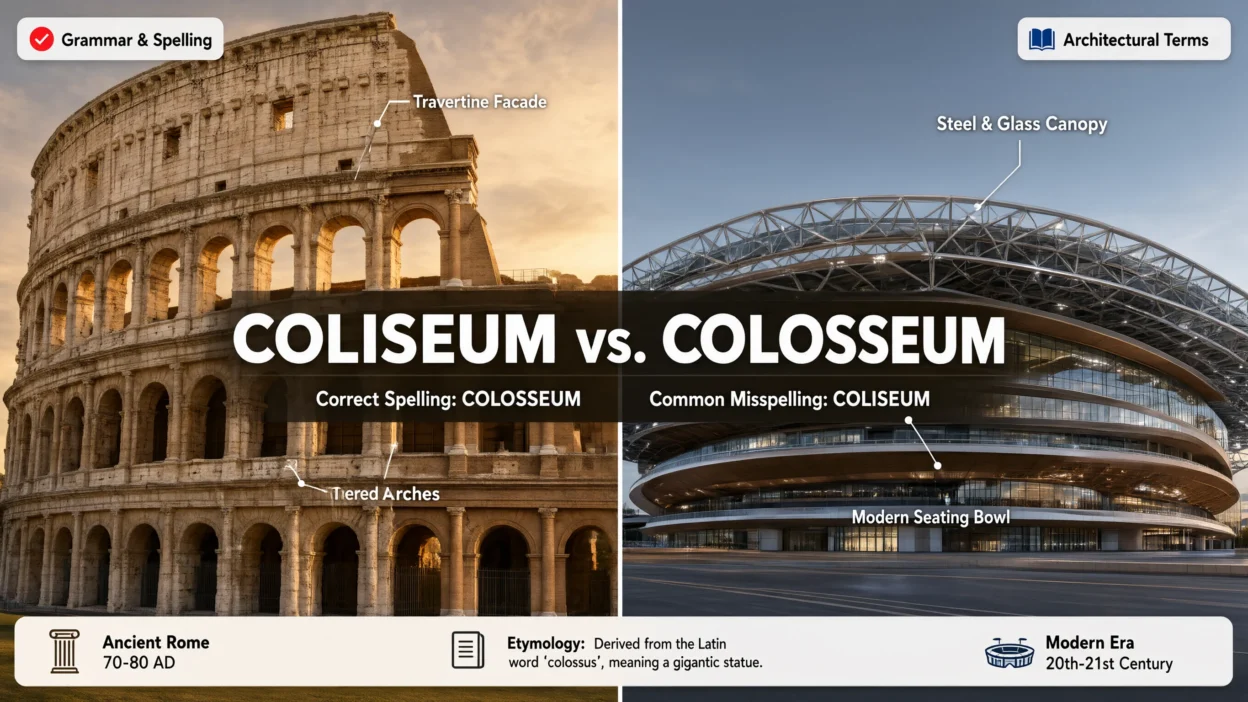
Have you ever wondered if the correct spelling is coliseum or colosseum? These two words look almost identical, sound very similar, and are often used when talking about large sports arenas, stadiums, and historical buildings. However, they have slightly different meanings and uses.
The word coliseum is a general term for a large stadium or arena used for sporting events, entertainment, and public gatherings. On the other hand, Colosseum (with a capital C) refers specifically to the famous ancient Roman amphitheatre in Rome, Italy. Although both spellings are accepted in English, choosing the right one depends on what you are describing.
In this guide, you will learn the difference between coliseum and Colosseum, discover when to use each spelling, and explore practical examples to help you remember them. If you are a student, English learner, writer, or general reader, understanding these words will make your writing clearer and more accurate.
Quick Answer: Coliseum or Colosseum?
Both coliseum and Colosseum are correct English spellings, but they have different uses. Coliseum generally means a large stadium or arena for public events. Colosseum refers specifically to the ancient Roman amphitheatre in Rome. Use a lowercase C for the general building and a capital C for the famous historical landmark.
Why Do People Confuse Coliseum and Colosseum?
People often confuse these words because they have almost identical pronunciations and meanings related to large arenas.
There are three main reasons for this confusion:
- Similar spelling: Both words contain almost the same letters, making them easy to mix up.
- Similar pronunciation: In everyday English, they are generally pronounced the same way.
- Related meanings: Both words are associated with large structures used for entertainment, performances, and public events.
Another reason is that the famous Roman Colosseum is sometimes called the Coliseum. This historical connection makes it harder to understand when each spelling is appropriate.
1. Coliseum: Meaning, Definition, and Examples
Coliseum is a noun that refers to a large stadium, arena, or building designed for public entertainment, sporting competitions, concerts, and other events.
It can describe a modern indoor or outdoor venue as well as a historical arena.
Definition: A large building or open space designed for public events, sports, performances, or entertainment.
Examples:
- Thousands of fans gathered at the coliseum for the championship.
- The city plans to build a new coliseum.
- Our school organized a sports competition at the local coliseum.
- The famous coliseum hosted several exciting events.
When to use Coliseum:
Use coliseum when referring to a general arena, stadium, or large entertainment venue.
For example:
“The basketball final will take place at the city coliseum.”
Here, the word describes a general sports and entertainment venue rather than a specific historical monument.
2. Colosseum: Meaning, Definition, and Examples
Colosseum is a proper noun that refers to the famous ancient Roman amphitheatre located in Rome, Italy.
It was built during the Roman Empire and is one of the most recognizable historical landmarks in the world.
Definition: The Colosseum is the ancient Roman amphitheatre in Rome that was used for gladiatorial contests, public spectacles, and other entertainment events.
Examples:
- The Colosseum is one of Rome’s most famous attractions.
- Millions of tourists visit the Colosseum.
- The ancient Colosseum is an important symbol of Roman history.
- We learned about the Colosseum in our history class.
When to use Colosseum:
Use Colosseum when specifically talking about the ancient Roman monument.
For example:
“My family visited the Colosseum during our trip to Italy.”
Here, the capitalized word identifies a particular historical landmark.
Coliseum vs Colosseum: Comparison Table
The following table highlights the main differences between these two words.
| Feature | Coliseum | Colosseum |
| Meaning | A large stadium or arena | Ancient Roman amphitheatre |
| Usage | General term | Specific historical landmark |
| Capitalization | Usually lowercase | Capital C |
| Word type | Common noun | Proper noun |
| Location | Can be anywhere | Rome, Italy |
| Context | Sports and entertainment | Roman history and tourism |
| Example | The city coliseum is crowded. | We visited the Colosseum. |
Important: Both spellings are accepted in English. The difference is mainly about whether you mean a general arena or the specific Roman landmark.
When Should You Use Coliseum or Colosseum?
Choosing between these words becomes easy when you understand the context.
Use Coliseum When:
- Talking about a general sports arena.
- Describing a large entertainment venue.
- Referring to a building used for concerts or competitions.
- Writing about a modern stadium.
- Describing a public event location.
Example: The concert will be held at the new coliseum.
Use Colosseum When:
- Talking about the ancient Roman monument.
- Describing Roman architecture.
- Writing about gladiators and ancient Roman entertainment.
- Discussing historical landmarks in Italy.
- Referring to the famous amphitheatre in Rome.
Example: The Colosseum attracts visitors from around the world.
12 Examples of Coliseum and Colosseum in Sentences
Learning through examples is one of the easiest ways to understand the difference between similar words.
Examples Using Coliseum
- The basketball tournament will take place at the local coliseum.
- Thousands of people attended the concert at the coliseum.
- The city built a modern coliseum for sporting events.
- Our team played an exciting match inside the coliseum.
- The new coliseum can accommodate thousands of spectators.
- The school arranged a graduation ceremony at the coliseum.
Examples Using Colosseum
- The Colosseum is located in the heart of Rome.
- Tourists travel to Italy to see the ancient Colosseum.
- Gladiatorial contests once took place inside the Colosseum.
- The Colosseum is an important part of Roman history.
- Our teacher showed us pictures of the Colosseum.
- The ancient Colosseum remains a popular tourist attraction.
These examples show that coliseum is suitable for general arenas, while Colosseum identifies the famous Roman structure.
Common Mistakes to Avoid
Even though both words are correct, people sometimes use them incorrectly.
Here are some common mistakes to watch out for.
Mistake 1: Using Colosseum for every stadium
Incorrect: Our basketball game will take place at the Colosseum.
Correct: Our basketball game will take place at the coliseum.
Explanation: Unless the game is taking place at the famous Roman landmark, use the general word coliseum.
Mistake 2: Writing the Roman landmark with a lowercase letter
Incorrect: We visited the colosseum in Rome.
Correct: We visited the Colosseum in Rome.
Explanation: The name of the specific historical monument is a proper noun, so it begins with a capital letter.
Mistake 3: Thinking one spelling is always wrong
Incorrect: Coliseum is an incorrect spelling.
Correct: Both coliseum and Colosseum are accepted spellings with different uses.
Explanation: Coliseum is a valid English word, not simply a misspelling of Colosseum.
Easy Memory Trick: How to Remember the Difference
Here is a simple trick to remember which spelling to use.
- Coliseum = Common arena: Think of a general stadium or entertainment venue.
- Colosseum = Roman landmark: Remember the extra O and the capital C in the famous monument’s name.
You can also remember this simple sentence:
“One coliseum can be anywhere, but the Colosseum is in Rome.”
This trick makes it easier to choose the correct spelling when writing.
American vs British English: Is There a Difference?
The distinction between coliseum and Colosseum is generally the same in American and British English.
Both varieties recognize coliseum as a general term for a large arena and Colosseum as the name of the ancient Roman monument.
| English Variety | General Arena | Roman Monument |
| American English | Coliseum | Colosseum |
| British English | Coliseum | Colosseum |
| Australian English | Coliseum | Colosseum |
| Canadian English | Coliseum | Colosseum |
There is no major American-versus-British spelling difference between these words.
Similar Words Related to Coliseum and Colosseum
Understanding related vocabulary can help you describe buildings, sports venues, and historical structures more accurately.
| Word | Meaning |
| Arena | A place where sports or entertainment events happen |
| Stadium | A large venue for sporting events |
| Amphitheatre | A circular or oval open structure with seating around a central area |
| Auditorium | A large room where people watch performances or presentations |
| Pavilion | A building or covered structure used for events |
| Theatre | A place where plays, performances, or shows take place |
| Sports complex | A facility containing sports venues and related facilities |
| Venue | A place where an event happens |
These words are related, but they are not always interchangeable. For example, an auditorium is generally designed for indoor presentations, while a stadium is usually associated with large sporting events.
Final Verdict: Coliseum or Colosseum?
The correct choice depends on what you are describing.
- Coliseum: Use this word for a general stadium, arena, or entertainment venue.
- Colosseum: Use this word for the famous ancient Roman amphitheatre in Rome, Italy.
Both spellings are correct, but they are not always interchangeable. Remember that Colosseum is a specific historical name, while coliseum is a general noun.
FAQs:
1. Is it Coliseum or Colosseum?
Both spellings are correct. Coliseum refers to a general stadium or arena, while Colosseum specifically refers to the famous ancient Roman amphitheatre in Rome.
2. Is Coliseum a misspelling of Colosseum?
No. Coliseum is a legitimate English word. It is commonly used to describe a large arena or public entertainment venue. Colosseum is the proper name of the ancient Roman monument.
3. Why is the Roman Colosseum spelled with two O’s?
The spelling Colosseum is the established English form of the historical monument’s name. It is traditionally associated with the Latin name Colosseum and the building’s historical identity.
4. Should Colosseum always be capitalized?
When referring to the famous Roman monument, yes. It is a proper noun and should begin with a capital C. When using coliseum as a general noun, lowercase is normally appropriate unless it begins a sentence or forms part of an official name.
5. Can I use Coliseum instead of Colosseum?
You may encounter Coliseum as an alternative spelling when referring to the Roman monument, but Colosseum is the standard and preferred spelling for its proper name. Use the capitalized form in historical and geographical writing.
6. What is the difference between a coliseum and an amphitheatre?
A coliseum generally refers to a large arena or entertainment venue. An amphitheatre is a specific type of structure with seating arranged around a central performance or event space. The Roman Colosseum is a famous example of an amphitheatre.
7. Where is the famous Colosseum located?
The famous Colosseum is located in Rome, Italy. It is an ancient Roman amphitheatre that once hosted gladiatorial contests and other public spectacles.
Remember This
- Coliseum = A general stadium or entertainment arena.
- Colosseum = The famous ancient Roman monument.
- Both spellings are correct in English.
- Use a capital C when writing the proper name Colosseum.
- Context determines which word you should choose.
Conclusion
The difference between coliseum and Colosseum is simple once you understand their meanings. Coliseum is a general word for a large stadium or arena used for sports, concerts, and public entertainment. Colosseum, on the other hand, is the specific name of the famous ancient Roman amphitheatre in Rome, Italy.
Although both spellings are accepted in English, using the right one makes your writing clearer and more accurate. Remember the simple rule: use coliseum for a general arena and Colosseum for the historical Roman landmark. With these examples and explanations, you can confidently use both words in everyday writing.

I’m Ethan Carter, Administrator at Instahuts. I manage content quality, improve user experience, and ensure every Instagram bio resource is accurate, creative, and helpful for users building standout online profiles.