
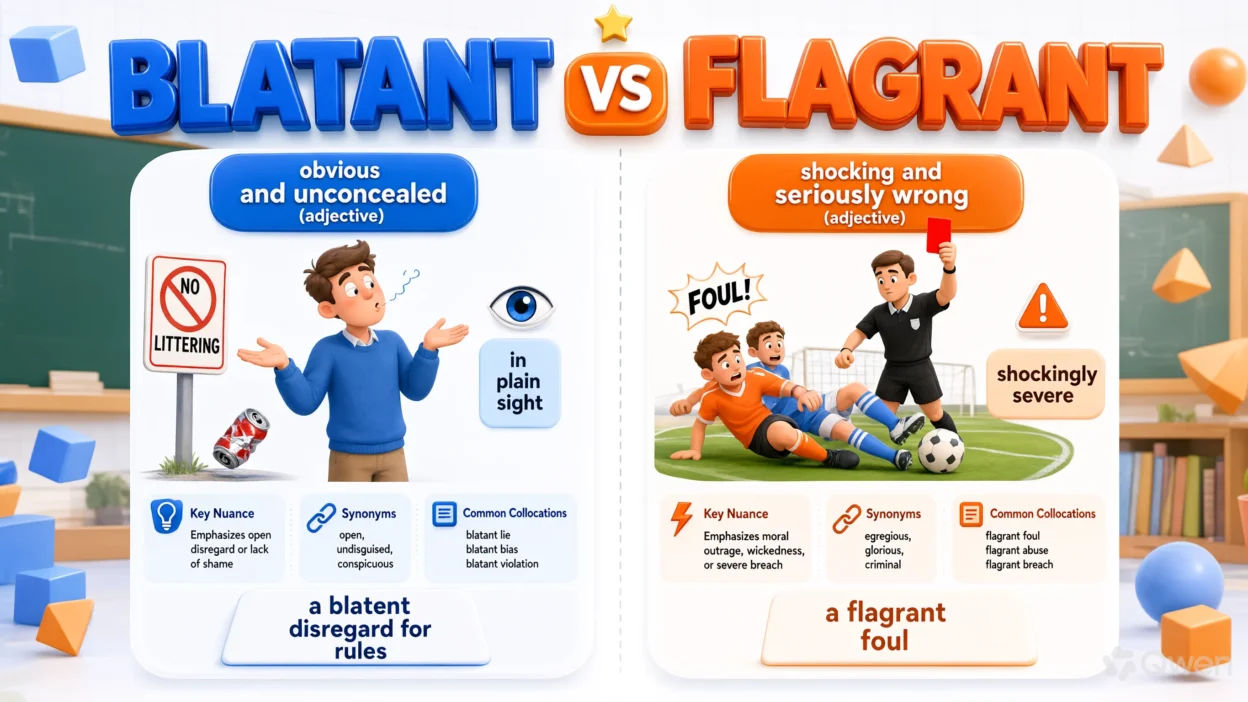
Have you ever wondered if to use blatant or flagrant when describing something obvious, offensive, or completely unacceptable? These two words are closely related, but they are not always interchangeable. Both can describe behavior that is difficult to ignore, yet each carries a slightly different meaning and tone.
Understanding the difference between blatant vs. flagrant can help you choose the right word in everyday conversations, academic writing, professional communication, and formal discussions. For example, a blatant lie is an obvious lie that is easy to recognize, while a flagrant violation is a serious and openly unacceptable breach of a rule or standard. The difference may seem small, but choosing the correct word makes your message clearer and more precise.
In this guide, you will learn what blatant and flagrant mean, how they differ, when to use each one, and how to remember their meanings through simple examples. Let’s explore these two commonly confused words.
Quick Answer: Blatant vs. Flagrant
Blatant describes something that is very obvious, noticeable, or done without trying to hide it. Flagrant describes something that is shockingly bad, offensive, or clearly against a rule or standard. Use blatant to emphasize obviousness and flagrant to emphasize seriousness or unacceptable behavior.
Why Do People Confuse Blatant and Flagrant?
People often confuse blatant and flagrant because both words describe actions or situations that are difficult to overlook.
They can also appear in similar contexts, especially when discussing dishonesty, misconduct, unfairness, and rule-breaking.
However, their main emphasis is different:
- Blatant focuses on how obvious or noticeable something is.
- Flagrant focuses on how serious, offensive, or unacceptable something is.
For example:
- She told a blatant lie during the meeting.
- The player committed a flagrant foul during the game.
In the first sentence, the lie was obvious. In the second, the foul was especially serious and unacceptable.
The easiest way to understand the difference is to remember that blatant is about visibility, while flagrant is about severity.
What Does Blatant Mean?
Blatant is an adjective that describes something extremely obvious, noticeable, or done openly without shame or an attempt to hide it.
It is commonly used when someone does something so clearly wrong, dishonest, or inappropriate that everyone can recognize it.
Simple Meaning: Extremely obvious, openly noticeable, or shamelessly apparent.
Examples of Blatant in Sentences
- He made a blatant mistake in his report.
- That was a blatant lie, and everyone knew it.
- She showed a blatant disregard for the rules.
- The advertisement contained blatant exaggerations.
- His behavior was a blatant attempt to get attention.
Common Synonyms of Blatant
- Obvious
- Clear
- Noticeable
- Conspicuous
- Evident
- Unmistakable
- Undisguised
- Open
- Unconcealed
- Shameless
When Should You Use Blatant?
Use blatant when you want to emphasize that something is easy to see, recognize, or identify.
Common expressions include:
- Blatant lie
- Blatant mistake
- Blatant disregard
- Blatant discrimination
- Blatant attempt
- Blatant hypocrisy
What Does Flagrant Mean?
Flagrant is an adjective that describes something extremely wrong, offensive, or unacceptable, especially when it involves breaking rules, laws, or moral standards.
It is often used in formal discussions, sports, legal contexts, and situations involving serious misconduct.
Simple Meaning: Shockingly wrong, offensive, or seriously unacceptable.
Examples of Flagrant in Sentences
- The referee penalized the player for a flagrant foul.
- The company committed a flagrant violation of safety regulations.
- His actions showed a flagrant disregard for human rights.
- The official was criticized for a flagrant abuse of power.
- The organization ignored a flagrant breach of its policies.
Common Synonyms of Flagrant
- Egregious
- Outrageous
- Shocking
- Gross
- Offensive
- Appalling
- Blatant
- Unacceptable
- Scandalous
- Heinous
When Should You Use Flagrant?
Use flagrant when describing something seriously wrong, offensive, or clearly violating an accepted rule or standard.
Common expressions include:
- Flagrant violation
- Flagrant foul
- Flagrant abuse
- Flagrant breach
- Flagrant misconduct
- Flagrant disregard
Blatant vs. Flagrant: Comparison Table
Although these adjectives overlap, their meanings and typical uses are different.
| Feature | Blatant | Flagrant |
| Part of speech | Adjective | Adjective |
| Main meaning | Extremely obvious | Shockingly wrong |
| Main emphasis | Visibility | Seriousness |
| Common tone | Critical or disapproving | Strongly critical |
| Typical use | Lies, mistakes, behavior | Violations, offenses, misconduct |
| Formality | Neutral to formal | Often formal |
| Example | Blatant lie | Flagrant violation |
| Main idea | Easy to notice | Seriously unacceptable |
Important distinction: Something can be blatant without being extremely serious. However, something described as flagrant is generally considered seriously wrong or offensive.
When to Use Blatant vs. Flagrant
Choosing between these words becomes easier when you understand what you want to emphasize.
Use Blatant When Something Is Obvious
Choose blatant when an action, statement, or mistake is so noticeable that it cannot easily be overlooked.
Examples:
- His excuse was a blatant lie.
- The company made a blatant error in its announcement.
- She showed blatant favoritism toward her friends.
In these examples, the focus is on how obvious the situation is.
Use Flagrant When Something Is Seriously Wrong
Choose flagrant when an action is particularly offensive, unacceptable, or against established rules.
Examples:
- The employee committed a flagrant violation of company policy.
- The referee punished the player for a flagrant foul.
- The politician was accused of flagrant misconduct.
Here, the focus is on the seriousness of the wrongdoing.
Can You Use Both Words in One Situation?
Yes. Sometimes an action can be both blatant and flagrant.
For example:
– The manager’s blatant and flagrant abuse of authority shocked the entire organization.
Blatant emphasizes how openly the abuse happened, while flagrant emphasizes how seriously unacceptable it was.
15 Examples of Blatant vs. Flagrant in Sentences
The following examples show how these words work in everyday and formal situations.
Examples Using Blatant
- His explanation was a blatant lie that nobody believed.
- The student made a blatant mistake during the examination.
- She showed blatant disrespect toward her teacher.
- The advertisement made blatant false claims about the product.
- His actions were a blatant attempt to avoid responsibility.
- The company demonstrated blatant favoritism toward certain employees.
- It was a blatant contradiction of his earlier statement.
- The driver showed blatant disregard for traffic signals.
Examples Using Flagrant
- The referee issued a penalty for a flagrant foul.
- The organization was investigated for a flagrant violation of safety standards.
- The official was accused of flagrant abuse of power.
- The employee committed a flagrant breach of workplace rules.
- The court condemned the flagrant misconduct.
- The company faced criticism for its flagrant disregard for environmental regulations.
- His actions represented a flagrant violation of public trust.
Common Mistakes When Using Blatant and Flagrant
Even fluent English speakers sometimes use these words incorrectly. Here are some mistakes worth avoiding.
Mistake 1: Treating Them as Perfect Synonyms
Although both words can describe unacceptable behavior, they do not emphasize the same thing.
Incorrect understanding: Blatant and flagrant always mean exactly the same thing.
Correct understanding:
- Blatant = extremely obvious.
- Flagrant = extremely wrong or offensive.
Mistake 2: Using Flagrant for Every Obvious Situation
Not everything noticeable is necessarily flagrant.
Less suitable: The sky was a flagrant shade of blue.
Better: The sky was a bright and noticeable shade of blue.
Flagrant is generally reserved for serious wrongdoing or offensive situations.
Mistake 3: Using Blatant When Seriousness Is the Main Point
If you want to emphasize a serious violation, flagrant may be more appropriate.
Less precise: The company committed a blatant violation of safety regulations.
More precise: The company committed a flagrant violation of safety regulations.
Both sentences can be grammatically correct, but flagrant places greater emphasis on the seriousness of the violation.
Mistake 4: Forgetting Their Different Emphasis
Remember that blatant describes how obvious something is, whereas flagrant describes how unacceptable it is.
Always consider the meaning you want to communicate before choosing one.
Easy Memory Trick to Remember Blatant vs. Flagrant
Here is a simple trick to remember the difference without memorizing complicated definitions.
Blatant = Barely Hidden
Think of something so obvious that nobody can miss it.
Examples:
- Blatant lie
- Blatant mistake
- Blatant favoritism
Flagrant = Fault That Is Extreme
Think of an action that seriously breaks rules or acceptable standards.
Examples:
- Flagrant violation
- Flagrant foul
- Flagrant misconduct
Remember: Blatant is about being obvious. Flagrant is about being seriously wrong.
Blatant vs. Flagrant in American and British English
Both blatant and flagrant are standard English adjectives used in American and British English.
Their core meanings remain the same in both varieties. There is no major spelling difference between them.
| Usage | American English | British English |
| Obvious dishonesty | Blatant lie | Blatant lie |
| Serious rule-breaking | Flagrant violation | Flagrant violation |
| Open disrespect | Blatant disrespect | Blatant disrespect |
| Serious misconduct | Flagrant misconduct | Flagrant misconduct |
The main difference is not regional but contextual. Speakers in both varieties use blatant for obvious behavior and flagrant for particularly serious wrongdoing.
Similar Words to Blatant and Flagrant
Several English adjectives have meanings related to blatant and flagrant. However, each word has its own emphasis.
| Word | Simple Meaning | Example |
| Obvious | Easy to notice | An obvious mistake |
| Egregious | Extremely bad | An egregious error |
| Outrageous | Shockingly unacceptable | Outrageous behavior |
| Conspicuous | Easily noticeable | A conspicuous change |
| Shameless | Without embarrassment | Shameless dishonesty |
| Appalling | Extremely unpleasant or shocking | Appalling treatment |
| Evident | Clearly seen or understood | Evident dishonesty |
| Gross | Very serious or unacceptable | Gross misconduct |
Blatant vs. Obvious
Obvious means easy to understand or notice. Blatant is stronger and often suggests that something is openly displayed in an inappropriate or shameless way.
Flagrant vs. Egregious
Both words describe extremely bad behavior or mistakes. However, egregious emphasizes how exceptionally bad something is, while flagrant often emphasizes an openly serious violation or offense.
Flagrant vs. Outrageous
Outrageous describes something shocking, unreasonable, or unacceptable. Flagrant is more commonly associated with serious wrongdoing or violations of rules and standards.
Final Verdict: Blatant or Flagrant?
The difference between blatant and flagrant comes down to obviousness versus seriousness.
Use blatant when something is extremely obvious, noticeable, or openly displayed. For example, a blatant lie is a lie that is easy to recognize.
Use flagrant when something is seriously wrong, offensive, or clearly violates rules or standards. For example, a flagrant violation is a particularly serious breach of a rule.
Both words can describe negative behavior, and sometimes they can be used together. However, choosing the right one makes your writing more accurate and meaningful.
FAQs:
1. Are blatant and flagrant the same?
No, blatant and flagrant are not exactly the same. Blatant means extremely obvious or noticeable, while flagrant means shockingly wrong, offensive, or unacceptable. They overlap when describing bad behavior, but their main emphasis is different.
2. Is blatant more negative than flagrant?
Generally, flagrant carries a stronger sense of seriousness or wrongdoing. Blatant can describe something obvious without necessarily suggesting an extremely serious offense. The context determines how negative either word sounds.
3. What is an example of a blatant lie?
A blatant lie is an obviously false statement that is difficult to believe. For example: He claimed he had never visited the office, even though everyone had seen him there that morning.
4. What is an example of a flagrant violation?
A flagrant violation is a particularly serious breach of a law, rule, or accepted standard. For example: The company committed a flagrant violation of workplace safety regulations by knowingly ignoring dangerous conditions.
5. Can blatant and flagrant be used together?
Yes. Both words can describe different aspects of the same action. For example: His blatant and flagrant disregard for the rules upset everyone. Blatant emphasizes how obvious his behavior was, while flagrant emphasizes how unacceptable it was.
6. What is the opposite of blatant?
Depending on the context, antonyms of blatant include subtle, hidden, discreet, concealed, and inconspicuous. These words describe something that is not immediately obvious or openly noticeable.
7. What is the opposite of flagrant?
Depending on the context, antonyms of flagrant include minor, acceptable, innocent, harmless, and unobjectionable. These words describe situations that are not seriously offensive or unacceptable.
Remember This
- Blatant means extremely obvious or noticeable.
- Flagrant means shockingly wrong or unacceptable.
- A blatant lie is easy to recognize.
- A flagrant violation is a serious breach of rules.
- Use blatant for obviousness and flagrant for seriousness.
Conclusion
Understanding blatant vs. flagrant is easier when you focus on their main differences. Although both words can describe negative situations, blatant emphasizes something obvious and openly noticeable, while flagrant highlights serious wrongdoing or unacceptable behavior. Knowing these meanings helps you communicate more clearly in everyday conversations and formal writing.
The next time you describe a lie, mistake, offense, or violation, think about what you want to emphasize. If something is impossible to miss, choose blatant. If something is seriously wrong, choose flagrant. Keep this simple distinction in mind, and you will use both words with confidence.

I’m Ethan Carter, Administrator at Instahuts. I manage content quality, improve user experience, and ensure every Instagram bio resource is accurate, creative, and helpful for users building standout online profiles.