
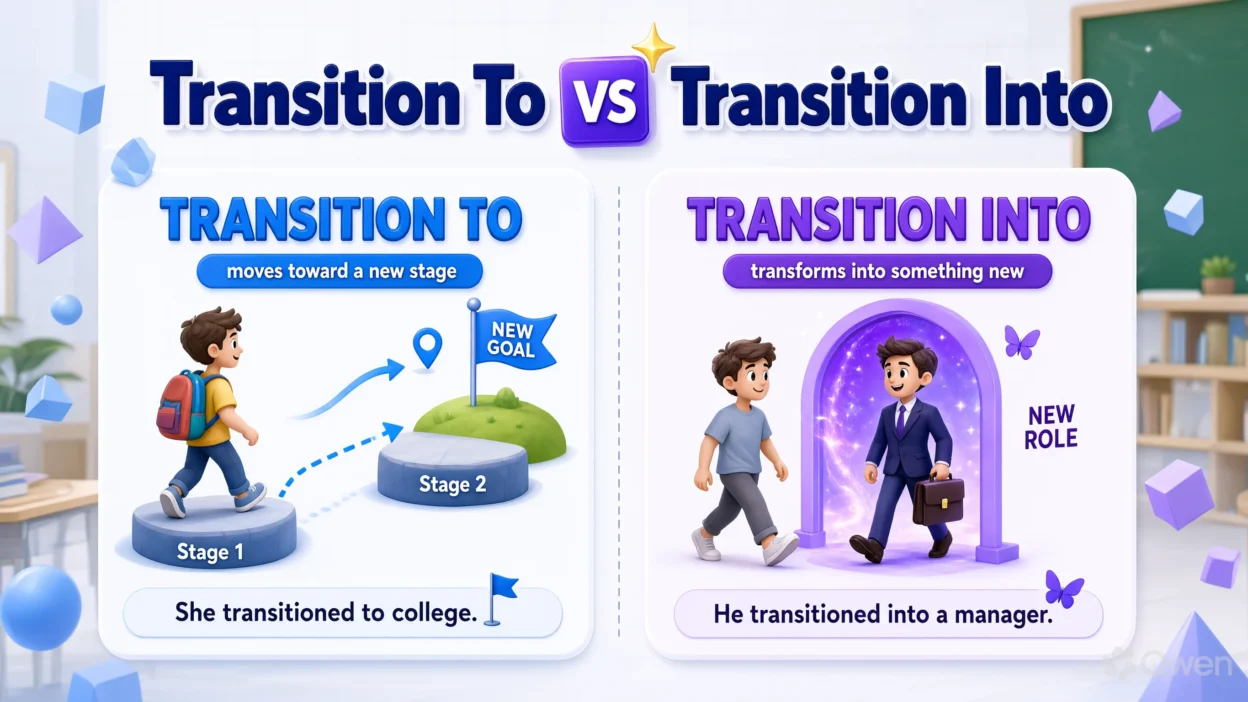
Choosing between transition to and transition into can be confusing because both phrases describe a change from one situation, condition, role, or stage to another. However, they are not always interchangeable. The correct choice depends on what you want to express and how the sentence is structured.
You might use these expressions when talking about changing jobs, moving to a new school, entering a different career, adapting to a new lifestyle, or shifting from one topic to another. Although both phrases communicate movement or change, transition to generally emphasizes the destination or next stage, while transition into often highlights entering a new state, role, condition, or environment.
Understanding this small difference can make your English sound more natural and precise. In this guide, you will learn what each phrase means, when to use it, how it works in everyday sentences, and which common mistakes to avoid.
Quick Answer
Transition to means moving from one situation, stage, or condition to another, often emphasizing the destination. Transition into means entering a new state, role, condition, or environment. For example, transition to a new school and transition into adulthood are both correct, but they emphasize slightly different ideas.
Why Do People Confuse Transition To and Transition Into?
People often confuse these expressions because both describe a process of change or movement from one thing to another.
The confusion comes from the fact that to and into can both introduce something that follows a change.
However, their meanings are slightly different:
- To usually points toward a destination, next stage, or new direction.
- Into emphasizes entering or becoming part of a new condition, role, or situation.
For example:
- She transitioned to a new department.
- She transitioned into a leadership role.
Both sentences describe change, but the first focuses on a new department, while the second emphasizes entering a new professional role.
1. What Does Transition To Mean?
Transition to means moving or changing from one situation, stage, place, or condition to another.
It is commonly used when describing a shift toward a new destination, system, phase, or arrangement.
Examples of Transition To
- The company will transition to a new management system.
- Students transition to college after high school.
- Our team is transitioning to remote work.
- She transitioned to a healthier lifestyle.
- The discussion transitioned to another topic.
- The country is transitioning to renewable energy.
When Should You Use Transition To?
Use transition to when you want to emphasize the destination or the next stage of a change.
Common situations include:
- Education: Transition to university.
- Work: Transition to a new department.
- Technology: Transition to digital services.
- Lifestyle: Transition to a healthier routine.
- Conversation: Transition to another subject.
- Business: Transition to a new operating system.
The phrase works naturally in both formal and informal English.
2. What Does Transition Into Mean?
Transition into means changing or developing into a new state, role, condition, or environment.
It emphasizes entering something new or becoming something different.
Examples of Transition Into
- She transitioned into a leadership position.
- The child is transitioning into adolescence.
- He transitioned into a new career.
- The business transitioned into a global organization.
- The weather is transitioning into winter.
- The discussion transitioned into a serious conversation.
When Should You Use Transition Into?
Use transition into when the change involves entering a new identity, condition, role, or stage.
Common situations include:
- Career: Transition into management.
- Personal development: Transition into adulthood.
- Business: Transition into a larger organization.
- Education: Transition into professional training.
- Relationships: Transition into married life.
- Seasons: Transition into winter.
The phrase is especially useful when describing a transformation or a new phase of life.
Transition To vs Transition Into: Comparison Table
| Feature | Transition To | Transition Into |
| Main meaning | Move toward a new destination or stage | Enter a new state or condition |
| Focus | Destination or direction | Entry or transformation |
| Common use | Systems, places, stages, topics | Roles, identities, conditions |
| Example | Transition to a new school | Transition into adulthood |
| Emphasis | Where the change leads | What someone or something becomes |
| Grammar | Transition to + noun/gerund | Transition into + noun/gerund |
Both expressions are grammatically correct. The difference is mainly about meaning and emphasis.
When to Use Transition To vs Transition Into
Understanding the context makes choosing the correct phrase much easier.
Use Transition To for Destinations and Next Stages
Choose transition to when describing movement toward a particular destination, arrangement, or stage.
Examples:
- We are transitioning to a new software platform.
- She transitioned to another university.
- The organization is transitioning to flexible working hours.
- He transitioned to a different department.
Here, the emphasis is on the new destination or arrangement.
Use Transition Into for New Roles and Conditions
Choose transition into when someone or something enters a different state, identity, or role.
Examples:
- He transitioned into a management role.
- The teenager is transitioning into adulthood.
- She transitioned into a successful entrepreneur.
- The company transitioned into a multinational business.
Here, the emphasis is on the new condition or identity.
Can You Use Both in Similar Situations?
Yes! Sometimes both expressions can work with the same general situation, but the emphasis changes.
For example:
- She transitioned to a leadership position.
- She transitioned into a leadership position.
Both are correct. The first presents the leadership position as her new destination. The second emphasizes her entry into the leadership role.
15 Examples of Transition To and Transition Into in Sentences
Here are practical examples to help you understand how both phrases work in everyday English.
Examples With Transition To
- Our school will transition to a new learning system next year.
- He decided to transition to a different career.
- The company is transitioning to renewable energy.
- She transitioned to a new job last month.
- Students often transition to college after graduation.
- The conversation quickly transitioned to politics.
- We are planning to transition to a healthier diet.
- The business will transition to online services.
Examples With Transition Into
- She successfully transitioned into a leadership role.
- My brother is transitioning into adulthood.
- He transitioned into the teaching profession.
- The small business transitioned into a large company.
- The discussion transitioned into an argument.
- The weather is transitioning into a colder season.
- She transitioned into her new responsibilities with confidence.
Common Mistakes With Transition To and Transition Into
Even fluent English speakers sometimes choose the wrong expression because they focus on the word transition rather than the meaning of the complete phrase.
Here are some mistakes to watch out for.
Mistake 1: Treating Both Expressions as Completely Identical
Incorrect understanding: Both phrases always mean exactly the same thing.
Better understanding: They overlap, but to emphasizes a destination, while into emphasizes entering a new condition or role.
Mistake 2: Using Into for Every Destination
Awkward: We transitioned into a new school.
More natural: We transitioned to a new school.
The second version is generally more natural when describing a move to another school.
Mistake 3: Forgetting the Noun or Gerund
Incorrect: She transitioned into become a manager.
Correct: She transitioned into becoming a manager.
After a preposition such as into, use a noun or an -ing form when a verb follows.
Mistake 4: Confusing Transition Into With Transition In
Incorrect: He transitioned in a leadership role.
Correct: He transitioned into a leadership role.
Use into when emphasizing entry into a new role or condition.
Mistake 5: Ignoring the Intended Meaning
Consider these examples:
- The company transitioned to a new system.
- The company transitioned into a new business model.
Both are possible, but the first emphasizes the new system, while the second emphasizes a change in the company’s business model.
Memory Trick: How to Remember the Difference
Here is an easy way to remember which phrase to use.
Transition TO = Destination
Think of to as pointing toward something new.
Example: I transitioned to a new school.
Transition INTO = Entering Something New
Think of into as stepping inside a new role, condition, or situation.
Example: I transitioned into adulthood.
Remember this simple question:
- Are you focusing on where someone is going? Use to.
- Are you focusing on what someone is entering or becoming? Use into.
This trick will help you choose the right expression in most everyday situations.
American vs British English: Is There a Difference?
There is no major difference between American and British English when using transition to and transition into.
Both expressions are grammatically acceptable and commonly understood in both varieties of English.
| Expression | American English | British English |
| Transition to a new job | Correct | Correct |
| Transition into adulthood | Correct | Correct |
| Transition to university | Correct | Correct |
| Transition into a leadership role | Correct | Correct |
| Transition to a new system | Correct | Correct |
The main differences you may notice involve vocabulary rather than grammar.
For example:
- American English: Transition to college.
- British English: Transition to university.
Both expressions follow the same grammatical principles.
Similar Words and Expressions
Several other words and phrases can express a change, movement, or transformation.
Understanding their meanings can help you choose more precise language.
| Word or Phrase | Meaning | Example |
| Shift to | Change direction or focus | Shift to a new strategy |
| Move to | Go to another place or stage | Move to another department |
| Change into | Become something different | Change into a new role |
| Convert to | Change into another form | Convert to digital format |
| Transform into | Become something significantly different | Transform into a leader |
| Adapt to | Become comfortable with something new | Adapt to a new environment |
| Progress to | Move forward to another stage | Progress to advanced training |
| Evolve into | Develop into something new | Evolve into a stronger business |
These alternatives are not always interchangeable with transition to or transition into. Choose the expression that best communicates your intended meaning.
Final Verdict: Transition To or Transition Into?
Both transition to and transition into are correct English expressions, but they emphasize different aspects of change.
Use transition to when talking about moving toward a destination, new stage, system, or arrangement.
Use transition into when describing entering a new role, identity, condition, or situation.
For example:
- She transitioned to a new department.
- She transitioned into a management role.
The easiest way to remember the difference is that to points toward a destination, while into emphasizes entering something new.
FAQs:
1. Is it transition to or transition into?
Both are correct. Use transition to for a destination or next stage and transition into when emphasizing entry into a new role, state, or condition.
2. Is transition into grammatically correct?
Yes. Transition into is grammatically correct when describing entry into a new situation, role, or condition.
Example: She transitioned into a leadership position.
3. Is transition to a new role correct?
Yes. Transition to a new role is correct because it describes moving toward a new professional position.
You can also say transition into a new role when emphasizing entering that position.
4. Should I say transition into adulthood or transition to adulthood?
Both expressions are correct, but transition into adulthood is particularly natural because it emphasizes entering a new stage of life.
5. Can transition to and transition into be used interchangeably?
Sometimes, but not always. Their meanings overlap when describing changes, but to emphasizes a destination, whereas into highlights entering a new state or role.
6. What preposition comes after transition?
The most common prepositions are to and into. The correct choice depends on the meaning and context of your sentence.
Examples:
- Transition to a new system.
- Transition into a new career.
7. Is it transition into a new career or transition to a new career?
Both are correct. Transition into a new career emphasizes entering a different professional field, while transition to a new career emphasizes moving toward a different career.
Remember This
- Transition to = Moving toward a destination, stage, or arrangement.
- Transition into = Entering a new role, identity, or condition.
- Both expressions are grammatically correct.
- The best choice depends on the meaning you want to communicate.
- American and British English follow the same general usage rules.
Conclusion
Understanding the difference between transition to and transition into makes your English clearer and more natural. Although both expressions describe change, they emphasize different ideas. Use transition to when focusing on a destination or next stage, and transition into when describing entry into a new role, condition, or situation.
With a little practice, choosing between these expressions becomes easier. Pay attention to the context, think about the type of change you are describing, and select the phrase that communicates your meaning best. Remember, to points toward something new, while into emphasizes entering something new.

I am Ryan Mitchell, an author at Instahuts passionate about creating engaging Instagram bio ideas. I enjoy helping readers express their personality through creative, stylish, and unique bios that make every profile stand out.