Have you ever wondered if to write for ever or forever? These two forms look almost identical, so it is easy to mix them up when writing a message, school assignment, email, or social media post. Although both forms have been used in English, they are not equally common in modern writing.
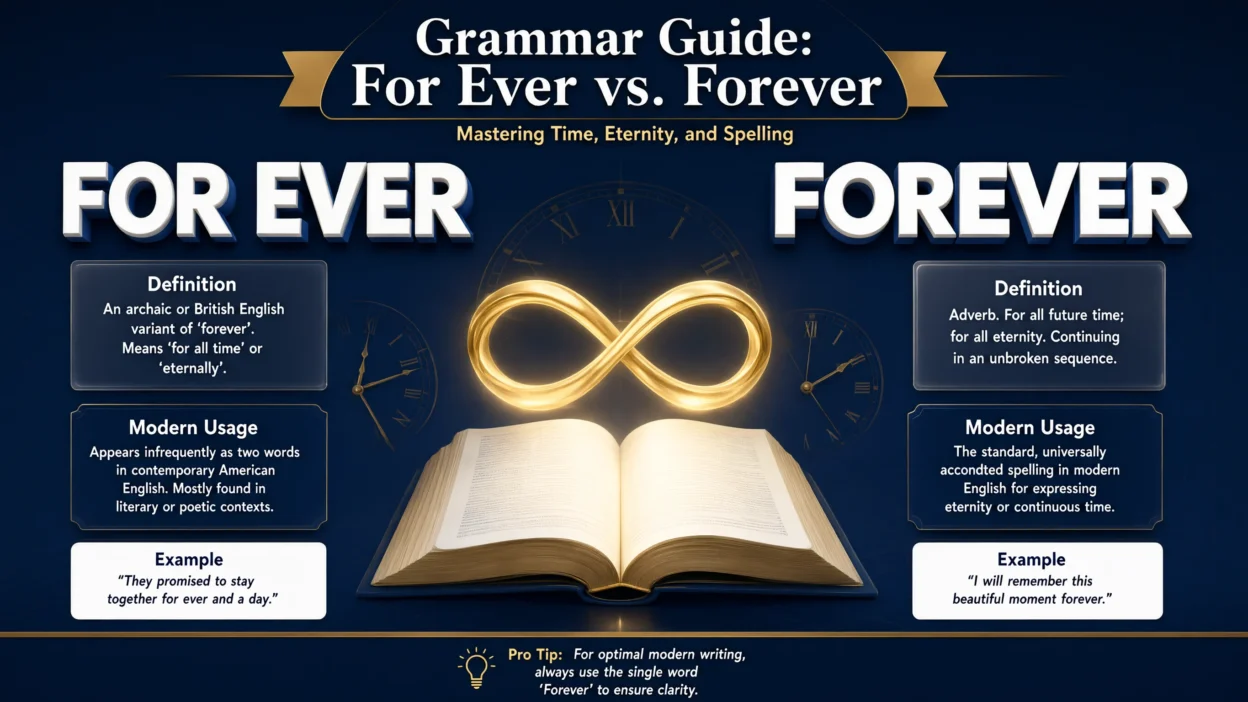
The good news is that the difference is simple. Forever is the standard spelling in modern American English and is also widely accepted in British English. For ever is traditionally used as two separate words in some British English contexts, particularly when emphasizing something continuing without end. However, most everyday writing uses forever. Understanding this distinction will help you choose the right form and avoid unnecessary spelling mistakes.
Quick Answer: For Ever or Forever?
Forever is the most common and widely accepted spelling. It means for all time, continuously, or without an end. For ever is an alternative traditional British spelling, but it is much less common in modern everyday writing. When in doubt, choose forever.
Why Do People Confuse For Ever and Forever?
People confuse for ever and forever because both expressions have the same basic meaning. They describe something that lasts for all time or continues without ending.
The confusion comes from their spelling and regional usage.
Here are the main reasons:
- Similar meaning: Both forms can communicate the idea of something lasting indefinitely.
- Different spelling: One is written as a single word, while the other uses two words.
- British and American differences: Traditional British writing has sometimes preferred for ever, while American English generally uses forever.
- Modern usage: Forever has become the dominant spelling in everyday English.
- Grammar confusion: Writers sometimes assume that two words must always be more grammatically correct than one.
The important thing to remember is that forever is the safest choice for most modern writing.
First Word: Forever
Forever is an adverb that means for all time, always, or without an end.
It describes something that continues indefinitely or seems to last for an extremely long time.
It is the standard spelling in American English and is widely used in British English.
Examples of Forever in Sentences:
- I will remember your kindness forever.
- They promised to stay together forever.
- This beautiful moment will last forever.
- Nothing stays the same forever.
- She wishes she could live here forever.
- True friendship can feel like it lasts forever.
When to Use Forever
Use forever when:
- You mean for all time or without an end.
- You are writing modern American English.
- You want the most widely recognized spelling.
- You are writing an email, article, essay, or social media post.
- You want to describe something lasting indefinitely.
Simple Definition: Forever means always or for all time.
Second Word: For Ever
For ever is an alternative spelling of forever, traditionally found in British English.
It generally communicates the same idea: for all time, permanently, or without an end.
Although this spelling is grammatically recognizable, it is less common in modern everyday writing. Many contemporary British writers also prefer the single-word form.
Examples of For Ever in Sentences:
- Their names will be remembered for ever.
- The ancient monument seemed destined to stand for ever.
- She believed their friendship would continue for ever.
- The story will remain in our hearts for ever.
- Some memories stay with us for ever.
When to Use For Ever
Use for ever when:
- You are following a traditional British English spelling preference.
- Your publication or style guide specifically requires the two-word form.
- You want to preserve the spelling used in a particular British text.
- You are discussing historical or literary writing.
Simple Definition: For ever means for all time or without an end.
For Ever vs Forever: Comparison Table
Here is a simple comparison to help you understand the difference.
| Feature | Forever | For Ever |
| Word type | Adverb | Two-word expression |
| Meaning | For all time | For all time |
| Spelling | One word | Two words |
| American English | Standard | Uncommon |
| British English | Standard and common | Traditional alternative |
| Modern usage | Very common | Less common |
| Best choice | Everyday writing | Specific style preferences |
Important: Both spellings can be correct, but forever is the preferred choice in most modern English writing.
When to Use Each: For Ever or Forever?
Choosing between these expressions depends mainly on your writing style and the spelling convention you are following.
Use Forever in Everyday Writing
Choose forever when you want a natural and widely accepted spelling.
Examples:
- I will love you forever.
- This memory will stay with me forever.
- They want to travel the world forever.
- Nothing lasts forever.
Use For Ever in Traditional British Writing
Choose for ever if you are following a traditional British spelling convention or a specific editorial style that prefers it.
Examples:
- Their contribution will be remembered for ever.
- The legend will live on for ever.
- The old castle seemed to stand for ever.
Which One Should You Choose?
If you are unsure, write forever. It is widely understood, accepted in both American and British English, and appropriate for almost every everyday situation.
15 Examples of Forever and For Ever in Sentences
The following examples show how both spellings work in natural English.
Examples Using Forever
- I will cherish these memories forever.
- You will always be my best friend forever.
- The stars seem to shine forever.
- She wants to stay young forever.
- Their love will remain strong forever.
- I could listen to this song forever.
- Time never waits for anyone forever.
- This photograph will remind me of you forever.
- He wishes summer could last forever.
- Some lessons stay with us forever.
Examples Using For Ever
- Their kindness will be remembered for ever.
- The beautiful painting will remain famous for ever.
- She believed their friendship would last for ever.
- The historic building seemed to stand for ever.
- His words will remain in my heart for ever.
Notice that the meaning remains essentially the same. The main difference is the spelling convention.
Common Mistakes with For Ever and Forever
Even experienced English writers sometimes make mistakes with these expressions.
Here are some common errors to avoid.
Mistake 1: Thinking Forever Is Incorrect
Incorrect assumption: Forever is not proper English.
Correct understanding: Forever is the standard modern spelling and is widely accepted.
Mistake 2: Using Both Forms Randomly
Incorrect approach: Switching between for ever and forever without following a consistent style.
Better approach: Choose one spelling convention and use it consistently.
Mistake 3: Assuming British English Always Requires For Ever
Incorrect assumption: British writers must always write for ever.
Correct understanding: Forever is also widely used and accepted in modern British English.
Mistake 4: Writing Forever as Two Words in Every Situation
Incorrect: I will remember you for evermore.
Better: I will remember you forever.
The best spelling depends on the expression and the style you are following.
Memory Trick: How to Remember Forever
Remember this simple trick:
Forever = For all time.
Think of forever as one continuous word describing something that never ends.
For everyday writing, remember:
- Forever: The standard modern spelling.
- For ever: A traditional alternative spelling.
An easy way to avoid confusion is to use forever whenever you are unsure.
American vs British English: For Ever or Forever
The difference between these spellings is often associated with American and British English.
However, the distinction is not as strict as some writers believe.
| English Variety | Preferred Modern Spelling |
| American English | Forever |
| British English | Forever |
| Traditional British usage | For ever |
| International English | Forever |
American English generally uses forever as one word.
Traditional British English has sometimes used for ever as two words, but modern British publications commonly use forever too.
Therefore, you do not need to change forever to for ever simply because you are writing for a British audience.
Similar Words to Forever and For Ever
If you want to express the idea of something lasting for all time, several other English words and phrases can help.
Here are some useful alternatives:
| Word or Phrase | Simple Meaning | Example |
| Always | At all times | I will always support you. |
| Eternally | For eternity | They will be eternally grateful. |
| Permanently | Without changing or ending | The decision was permanently recorded. |
| Endlessly | Without stopping | The children talked endlessly. |
| Perpetually | Continuously | He is perpetually busy. |
| Evermore | Forever or from now on | Their story will live evermore. |
| For eternity | For all time | Their love will last for eternity. |
| In perpetuity | Forever or indefinitely | The agreement remains valid in perpetuity. |
These alternatives can make your writing more varied and expressive.
Final Verdict: For Ever or Forever?
The correct choice for most modern English writing is forever.
Both forever and for ever have been used to express the meaning of something lasting for all time. However, forever is the standard and more widely used spelling in contemporary American and British English.
Use for ever when following a traditional British spelling preference or a specific style guide. Otherwise, choose forever for everyday communication, professional writing, academic assignments, and social media posts.
FAQs:
1. Is It For Ever or Forever?
Forever is the standard modern spelling. For ever is a traditional alternative, particularly associated with British English. Both forms express the idea of something lasting for all time.
2. Is Forever One Word or Two Words?
Forever is written as one word. It is an adverb meaning always, for all time, or without an end. It is the most common spelling in modern English.
3. Is For Ever Grammatically Correct?
Yes, for ever is a recognized traditional spelling. It has been used in British English, although forever is now much more common in everyday writing.
4. Do British People Write Forever or For Ever?
Both forms can be found in British English. Forever is widely used in modern British writing, while for ever is a traditional alternative.
5. Is Forever Correct in American English?
Yes. Forever is the standard spelling in American English. The two-word form for ever is uncommon in American writing.
6. What Is Another Word for Forever?
Common alternatives include always, eternally, permanently, endlessly, perpetually, and evermore. The best alternative depends on the meaning and context of your sentence.
7. Does Forever Mean Always?
Forever can mean always or for all time. However, the exact meaning depends on context. It can describe something permanent or simply something that feels like it lasts a very long time.
Remember This
- Forever is the standard modern spelling.
- For ever is a traditional alternative.
- Both expressions can mean for all time.
- American English generally prefers forever.
- Modern British English also commonly uses forever.
- When in doubt, choose forever.
Conclusion
Understanding the difference between for ever and forever is easier than it looks. Both forms communicate the idea of something lasting indefinitely, but forever is the more common and widely accepted spelling in modern English. The two-word form is mainly associated with traditional British usage.
Whenever you write an essay, email, social media caption, or everyday message, remember to use forever unless a particular style guide requires otherwise. A small spelling choice can make your writing clearer and more consistent!

I’m Ethan Carter, Administrator at Instahuts. I manage content quality, improve user experience, and ensure every Instagram bio resource is accurate, creative, and helpful for users building standout online profiles.