
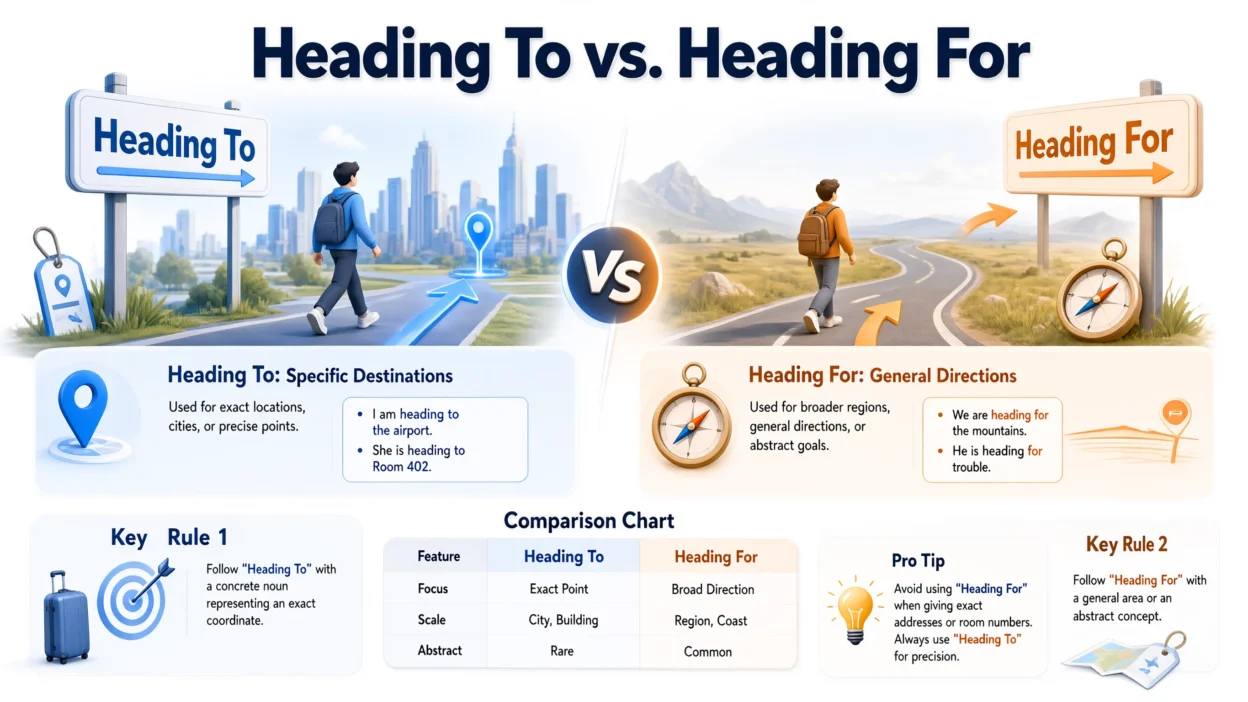
When writing or speaking English, choosing between heading to and heading for can sometimes be confusing. Both expressions describe movement toward a destination, but they are not always interchangeable. If you have ever wondered whether to say I am heading to school or I am heading for school, understanding their differences will help you speak and write more naturally.
The good news is that both phrases are grammatically correct. The difference depends on what you want to communicate. Heading to generally identifies the destination someone is traveling toward, while heading for can describe moving in a particular direction, aiming for a destination, or moving toward a possible result.
In this guide, you will learn their meanings, grammatical uses, differences, and common mistakes. You will also find practical examples, memory tricks, and answers to frequently asked questions to help you choose the right expression confidently.
Quick Answer: Heading To or Heading For?
Heading to is generally used when someone is traveling to a specific destination, such as school, work, or home. Heading for is used when someone is moving toward a particular place, direction, goal, or outcome. For example, I am heading to work describes a destination, while The storm is heading for the coast describes its direction.
Why Do People Confuse Heading To and Heading For?
People often confuse these expressions because both contain the word heading and describe movement toward something.
However, the prepositions to and for communicate slightly different relationships.
- To usually connects movement with a destination or endpoint.
- For can indicate direction, intended destination, purpose, or an expected result.
For example:
- I am heading to the airport. (The airport is my destination.)
- The ship is heading for the harbor. (The harbor is the direction or intended destination.)
In everyday conversation, both expressions can sometimes describe similar situations. Understanding the context makes choosing between them much easier.
What Does Heading To Mean?
Heading to means traveling or moving toward a particular destination.
It is commonly used when talking about places someone plans to visit or locations they are traveling toward.
When to Use Heading To
Use heading to when:
- Talking about a specific destination.
- Describing everyday travel.
- Explaining where someone is going.
- Discussing plans to visit a particular place.
- Informally telling someone where you are going.
Examples of Heading To
- I am heading to work now.
- She is heading to the supermarket.
- We are heading to London tomorrow.
- They are heading to the airport.
- He is heading to school early today.
- I am heading to bed because I am tired.
Remember: Heading to is the natural choice when you want to identify where someone is going.
What Does Heading For Mean?
Heading for means moving in the direction of something, aiming toward a destination, or approaching a particular result.
It can describe physical movement as well as situations that are developing toward an outcome.
When to Use Heading For
Use heading for when:
- Describing movement in a particular direction.
- Talking about an intended destination.
- Explaining someone’s aim or goal.
- Describing an approaching situation or outcome.
- Talking about something moving toward a particular place.
Examples of Heading For
- The plane is heading for New York.
- We are heading for the beach.
- The company is heading for success.
- The storm is heading for the coastline.
- He is heading for trouble.
- Our team is heading for victory.
Remember: Heading for often emphasizes direction, intention, or an expected outcome rather than simply identifying a destination.
Heading To vs Heading For: Comparison Table
| Feature | Heading To | Heading For |
| Main meaning | Moving toward a destination | Moving toward a direction, goal, or result |
| Main purpose | Identifies where someone is going | Emphasizes direction or intended outcome |
| Common use | Everyday travel | Travel, goals, and situations |
| Example | Heading to school | Heading for trouble |
| Focus | Destination | Direction or outcome |
| Grammar | Heading + to | Heading + for |
Both expressions are correct, but their meanings and natural contexts can differ.
When to Use Heading To vs Heading For
Choosing the correct expression becomes easier when you understand the situation.
Use Heading To for Specific Destinations
When someone is traveling to a particular place, heading to is usually the most natural expression.
Examples:
- I am heading to the office.
- We are heading to the restaurant.
- She is heading to the university.
Use Heading For to Describe Direction
When emphasizing the direction something is moving, heading for is often appropriate.
Examples:
- The boat is heading for the island.
- The car is heading for the bridge.
- The plane is heading for the airport.
Use Heading For to Describe an Outcome
Heading for can also describe something that is likely to happen.
Examples:
- He is heading for success.
- They are heading for a difficult situation.
- The business is heading for financial trouble.
Can Both Expressions Describe the Same Journey?
Yes. In some situations, both expressions can describe movement toward the same destination.
For example:
- We are heading to the beach.
- We are heading for the beach.
Both are understandable and natural in many contexts. The first directly identifies the destination, while the second can emphasize the intended direction or destination.
12 Examples of Heading To and Heading For in Sentences
Here are practical examples to help you understand how both expressions work in everyday English.
Examples Using Heading To
- I am heading to the gym after work.
- She is heading to her friend’s house.
- We are heading to the airport at six.
- My parents are heading to the city today.
- He is heading to the library to study.
- They are heading to the hotel after dinner.
Examples Using Heading For
- The storm is heading for the eastern coast.
- We are heading for the mountains this weekend.
- She is heading for a successful career.
- The company is heading for a challenging year.
- The football team is heading for victory.
- He ignored the warning and was heading for trouble.
These examples show that the correct preposition depends on the meaning and context of the sentence.
Common Mistakes When Using Heading To and Heading For
Even English learners sometimes use these expressions incorrectly. Here are some mistakes worth avoiding.
Mistake 1: Thinking Both Expressions Always Mean the Same Thing
Incorrect understanding: Heading to and heading for are interchangeable in every sentence.
Correct understanding: Their meanings overlap when describing destinations, but heading for can also describe goals and outcomes.
Mistake 2: Using Heading To for an Expected Result
Awkward: He is heading to trouble.
Better: He is heading for trouble.
Heading for is the natural expression when describing an approaching negative outcome.
Mistake 3: Forgetting the Preposition
Incorrect: I am heading the airport.
Correct: I am heading to the airport.
You generally need a preposition when using heading to or heading for in these meanings.
Mistake 4: Confusing Heading For With Heading From
These expressions communicate different ideas.
- Heading to work means traveling toward work.
- Heading for work means setting out in the direction of work.
- Heading from work means leaving work or traveling away from it.
Always consider the direction of movement.
Easy Memory Trick to Remember the Difference
Here is a simple way to remember these expressions:
- TO = Destination: Think about where you are going.
- FOR = Direction or Goal: Think about what you are moving toward or what may happen.
For example:
- Heading to school = Your destination is school.
- Heading for success = Your goal or expected outcome is success.
One simple trick is to remember that to points to a place, while for can point to a direction or future result.
Heading To vs Heading For in American and British English
Both expressions are used in American and British English.
There is no major difference in their basic meanings between these varieties of English.
| Expression | American English | British English |
| Heading to work | Common | Common |
| Heading to school | Common | Common |
| Heading for home | Common | Common |
| Heading for trouble | Common | Common |
| Heading for success | Common | Common |
The choice depends more on the intended meaning and sentence context than on whether you are using American or British English.
Similar Words and Expressions
If you want to expand your English vocabulary, these expressions can also help you describe movement and direction.
- Going to: Traveling or planning to visit somewhere.
- Traveling to: Moving from one place to another.
- Making for: Moving toward a particular place.
- Bound for: Intended to reach a particular destination.
- On the way to: Traveling toward a destination.
- Moving toward: Changing position in the direction of something.
- Aiming for: Trying to achieve a particular goal.
- Setting off for: Beginning a journey toward a destination.
Examples:
- I am going to school.
- The train is bound for Manchester.
- We are making for the nearest village.
- She is aiming for success.
These alternatives make your English more natural and expressive.
Final Verdict: Heading To or Heading For?
Both heading to and heading for are correct English expressions.
Use heading to when you want to identify a destination, such as work, school, home, or the airport.
Use heading for when emphasizing direction, intention, a goal, or an expected result, such as success, trouble, or victory.
Although the expressions sometimes overlap when describing travel, they are not interchangeable in every situation. Always consider what you want your sentence to communicate.
FAQs:
1. Is it heading to or heading for?
Both are correct. Heading to generally identifies a destination, while heading for emphasizes direction, intention, or an expected outcome. The right choice depends on the sentence.
2. Is heading to grammatically correct?
Yes. Heading to is grammatically correct and commonly used in everyday English.
Example: I am heading to the office.
3. Is heading for grammatically correct?
Yes. Heading for is also grammatically correct.
Example: The company is heading for success.
4. Can I say I am heading for work?
Yes. I am heading for work is correct and means you are setting out toward your workplace. I am heading to work is also very common.
5. Should I say heading to the airport or heading for the airport?
Both expressions are correct. Heading to the airport directly identifies your destination, while heading for the airport emphasizes setting out in that direction.
6. What does heading for trouble mean?
Heading for trouble means moving toward a situation that is likely to cause problems or difficulties.
Example: If you keep ignoring the rules, you are heading for trouble.
7. Is heading to used in formal English?
Yes. Heading to is grammatically acceptable in both formal and informal English. However, in highly formal writing, expressions such as traveling to or proceeding to may sometimes be more suitable.
Remember This
- Heading to = A destination.
- Heading for = A direction, intention, goal, or expected result.
- Both expressions are grammatically correct.
- Context determines which expression sounds most natural.
Conclusion
Understanding the difference between heading to and heading for makes everyday English easier and more natural. Although both expressions describe movement toward something, heading to usually focuses on a destination, while heading for can emphasize direction, intention, or an expected outcome.
The next time you are writing or speaking, think about what you want to express. If you are talking about where someone is going, choose heading to. If you are describing a direction, goal, or possible result, heading for may be the better choice. With a little practice, you will use both expressions confidently.

I am Ryan Mitchell, an author at Instahuts passionate about creating engaging Instagram bio ideas. I enjoy helping readers express their personality through creative, stylish, and unique bios that make every profile stand out.