Have you ever wondered if to write that’s mean or that means? These two expressions look and sound similar, but they have different meanings and grammatical uses. Choosing the wrong one can make your sentence confusing or grammatically incorrect. The good news is that understanding the difference is easier than you might think.
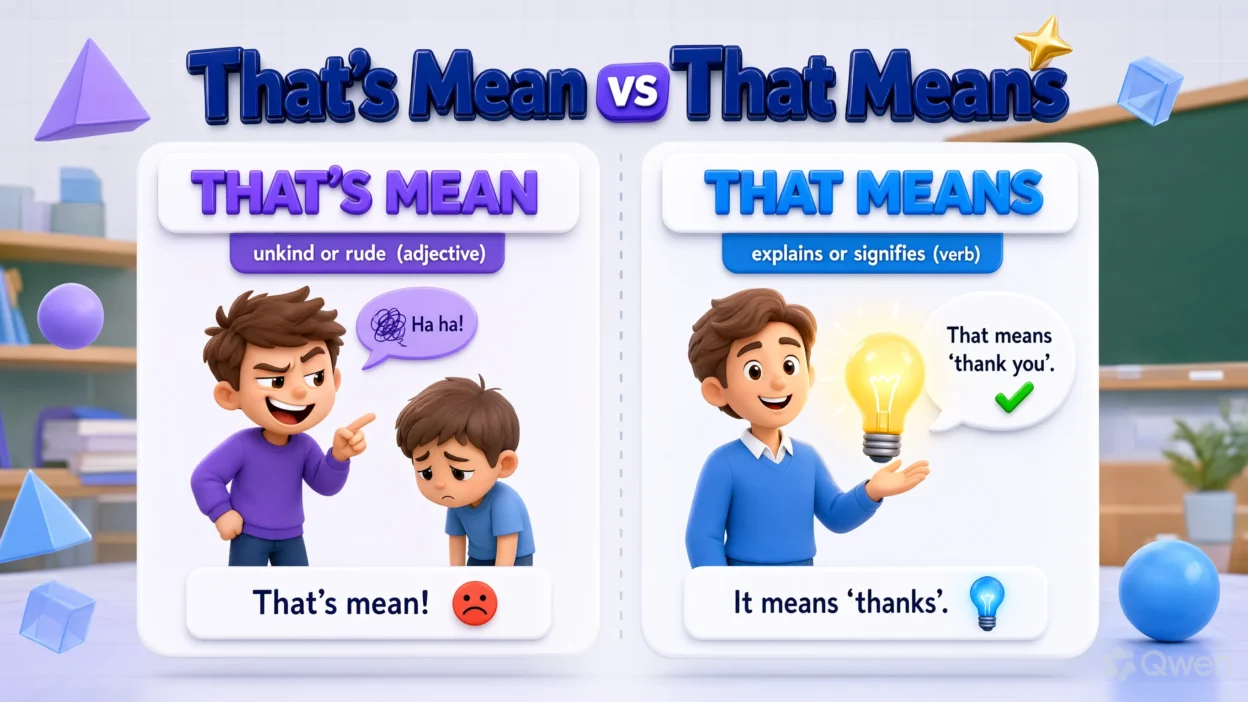
The main difference is that that’s mean usually describes something as unkind, rude, or unpleasant, while that means explains what something signifies, indicates, or leads to. For example, you might say That’s mean! when someone makes a hurtful comment.
However, you would say That means we need to leave early when explaining a result or situation. In this guide, you’ll learn how to use both expressions correctly, understand their grammatical differences, and see practical examples that make the distinction easy to remember.
Quick Answer: That’s Mean vs. That Means
That’s mean means that something is unkind, hurtful, or unpleasant. Here, that’s is a contraction of that is. That means means that something indicates, explains, or results in something. Here, means is the third-person singular form of the verb mean. Use that’s mean to describe behavior and that means to explain meaning or consequences.
Why Do People Confuse That’s Mean and That Means?
People often confuse these expressions because they contain similar words and have almost identical pronunciation.
However, their grammatical structures are different:
- That’s mean: That is + mean (an adjective).
- That means: That + means (a verb).
The word mean can function as either an adjective or a verb.
As an adjective, mean describes someone or something unkind or unpleasant.
As a verb, mean refers to what something signifies, represents, or intends.
For example:
- That’s mean of you. (Describes unkind behavior.)
- That means you understand. (Explains what something indicates.)
Understanding these grammatical roles will help you choose the correct expression.
What Does That’s Mean Mean?
That’s mean is a phrase used to describe something as unkind, rude, hurtful, or unpleasant.
In this expression, that’s is the contraction of that is, and mean is an adjective.
People commonly use it in everyday conversations when someone says or does something unkind.
Examples of That’s Mean
- That’s mean of you to laugh at her mistake.
- That’s mean! You should apologize to him.
- Saying something like that is mean.
- That’s mean to make fun of someone’s appearance.
- That’s mean behavior toward your friends.
When Is That’s Mean Correct?
Use that’s mean when you want to:
- Describe an unkind comment.
- React to someone’s rude behavior.
- Explain that an action is hurtful.
- Express disappointment about someone’s treatment of another person.
Example: You made fun of his new haircut. That’s mean!
Here, the speaker is describing the behavior as unkind.
What Does That Means Mean?
That means is an expression used to explain what something signifies, indicates, or results in.
In this expression, that is the subject, and means is the verb. It is the third-person singular form of mean in the present simple tense.
People use it to explain information, clarify situations, or describe consequences.
Examples of That Means
- That means we have to start again.
- If she is absent, that means she is not coming today.
- That means you passed the examination.
- Your invitation means a lot to me.
- That means everything is ready.
When Is That Means Correct?
Use that means when you want to:
- Explain the meaning of something.
- Clarify information.
- Describe a result or consequence.
- Draw a conclusion from a situation.
- Explain what someone’s words or actions indicate.
Example: The shop is closed today. That means we need another place to eat.
Here, that means introduces a consequence of the shop being closed.
That’s Mean vs. That Means: Comparison Table
| Feature | That’s Mean | That Means |
|---|---|---|
| Grammar | That is + adjective | Subject + verb |
| Main purpose | Describes unkindness | Explains meaning |
| Meaning | Unkind or hurtful | Indicates or signifies |
| Word type | Mean is an adjective | Means is a verb |
| Usage | Emotional reactions | Explanations and conclusions |
| Example | That’s mean of you. | That means we are late. |
The easiest way to distinguish them is to check whether you are describing someone’s behavior or explaining what something means.
When Should You Use That’s Mean or That Means?
Both expressions are correct, but they belong in different situations.
Use That’s Mean When Describing Unkindness
Choose that’s mean when someone behaves rudely or says something hurtful.
Examples:
- That’s mean to say about your friend.
- That’s mean of him to ignore her.
- That’s mean! Don’t make fun of people.
Use That Means When Explaining Something
Choose that means when you are explaining information, a result, or a conclusion.
Examples:
- The deadline is tomorrow. That means we must finish today.
- He has a fever. That means he should rest.
- You won the competition. That means your hard work paid off.
Can You Use Both in One Conversation?
Yes! Both expressions can appear naturally in the same conversation.
Example:
Person A: You told everyone about her secret.
Person B: I didn’t know it was private.
Person A: That’s mean, and that means you should apologize.
In this example, that’s mean describes the action as unkind, while that means introduces a conclusion.
15 Examples of That’s Mean vs. That Means in Sentences
Here are practical examples to help you understand the difference.
Examples Using That’s Mean
- That’s mean of you to leave your friend alone.
- That’s mean! She worked really hard on that project.
- That’s mean to laugh at someone who is struggling.
- That’s mean behavior, and you should stop it.
- That’s mean of him to spread false rumors.
- That’s mean! Nobody deserves to be treated that way.
- That’s mean to criticize someone without knowing the truth.
- That’s mean of them to exclude her from the group.
Examples Using That Means
- You forgot your keys. That means we cannot enter the house.
- She speaks three languages. That means she is multilingual.
- The train is delayed. That means we will arrive late.
- You finished your homework. That means you can relax now.
- He didn’t answer the phone. That means he might be busy.
- The weather is getting colder. That means winter is approaching.
- Your application was accepted. That means you got the position.
Common Mistakes to Avoid
Even though these expressions are simple, some mistakes are common among English learners.
1. Using That’s Mean to Explain a Result
Incorrect: That’s mean we need more time.
Correct: That means we need more time.
Why? Means is the verb needed to explain what the situation indicates.
2. Using That Means to Describe Unkind Behavior
Incorrect: That means of you to say that.
Correct: That’s mean of you to say that.
Why? Mean is an adjective describing unkind behavior.
3. Forgetting the Apostrophe in That’s
Incorrect: Thats mean of you.
Correct: That’s mean of you.
Why? That’s is a contraction of that is, so it requires an apostrophe.
4. Confusing Mean With Means
Incorrect: That mean we are late.
Correct: That means we are late.
Why? The subject that is singular, so the present-tense verb takes -s.
5. Thinking That’s Always Means That Is
In this particular comparison, that’s means that is. However, that’s can also mean that has in other sentence structures.
For example:
- That’s a beautiful dress. (That is.)
- That’s been a difficult year. (That has.)
Understanding the context helps you identify the correct meaning.
Memory Trick: How to Remember the Difference
Use this simple memory trick:
- That’s mean = That’s unkind.
- That means = That explains something.
Remember these two questions:
- Are you describing something rude or hurtful? Use that’s mean.
- Are you explaining information or a result? Use that means.
You can also remember that mean describes behavior, while means explains meaning.
With a little practice, choosing between these expressions will become natural.
American vs. British English: Is There Any Difference?
There is no meaningful grammatical difference between American and British English when using that’s mean and that means.
Both expressions are understood and used in both varieties of English.
| Expression | American English | British English |
|---|---|---|
| That’s mean! | Correct | Correct |
| That means we are late. | Correct | Correct |
| That’s mean of you. | Correct | Correct |
| That means a lot. | Correct | Correct |
The spelling and grammatical rules remain the same. The choice depends on the intended meaning, not the variety of English.
Similar Words and Expressions
Learning related words can help you understand these expressions more clearly.
Alternatives to That’s Mean
When describing unkind behavior, you can use:
- That’s unkind.
- That’s rude.
- That’s cruel.
- That’s hurtful.
- That’s inconsiderate.
- That’s disrespectful.
- That’s unfair.
Example: That’s unkind of you to ignore your friend.
Alternatives to That Means
When explaining something, you can use:
- That indicates.
- That suggests.
- That signifies.
- That implies.
- In other words.
- This shows that.
- This means that.
Example: The roads are wet. That indicates it has probably rained.
Choose the alternative that best matches your sentence and intended meaning.
Final Verdict: That’s Mean or That Means?
Both that’s mean and that means are grammatically correct, but they serve different purposes.
- Use that’s mean when describing something unkind, rude, or hurtful.
- Use that means when explaining what something signifies or what result it produces.
For example, That’s mean of you to say that describes unkind behavior, while That means we should leave early explains a consequence.
Always remember: mean describes behavior, while means explains meaning.
FAQs:
1. Is it that’s mean or that means?
Both are correct, but their meanings are different. That’s mean describes something unkind or hurtful, while that means explains what something signifies or indicates.
2. Is that’s mean grammatically correct?
Yes. That’s mean is grammatically correct when mean is used as an adjective to describe something unkind, rude, or hurtful.
Example: That’s mean of you to say that.
3. What does that means mean?
That means is used to explain what something signifies, indicates, or results in.
Example: The bus is late. That means we need to wait.
4. Why do we say that means instead of that mean?
Because that is a third-person singular subject. In the present simple tense, the verb mean becomes means when used with that.
Example: That means everything is fine.
5. Can I say that’s mean to you?
It is understandable, but the more natural expression depends on your intended meaning.
- That’s mean of you means your behavior is unkind.
- That’s mean to you can describe something as unkind toward you, but That’s unkind to you is often more natural.
6. Is that’s mean the same as that’s rude?
They have similar meanings, but they are not always interchangeable. That’s mean usually emphasizes unkindness or hurtful behavior, while that’s rude emphasizes impolite or disrespectful behavior.
7. How do I use that means in a sentence?
Use that means when explaining a meaning, result, or consequence.
Example: She didn’t attend the meeting. That means she might not know about the changes.
Remember This
- That’s mean = That is unkind.
- That means = That signifies or indicates something.
- Use that’s mean to describe behavior.
- Use that means to explain information or consequences.
- Both expressions are correct when used in the right context.
Conclusion
Understanding the difference between that’s mean and that means is simple once you recognize their grammatical roles. That’s mean uses mean as an adjective to describe unkind or hurtful behavior, whereas that means uses means as a verb to explain information, meaning, or consequences. Both expressions are useful in everyday English conversations and writing.
The next time you use these phrases, think about what you want to communicate. If you’re describing something unkind, choose that’s mean. If you’re explaining what something indicates, choose that means. Remember this simple distinction, practice the examples, and you’ll use both expressions confidently.

I am Daniel Brooks, a passionate writer at Instahuts who enjoys creating engaging Instagram bio ideas. I help readers express their personalities with creative, stylish, and meaningful bios that make every profile stand out.