Have you ever wondered if to write joint or join? These two words look and sound similar, so it is easy to mix them up. However, they have different meanings and grammatical uses. Knowing the difference will help you write clearer sentences and avoid common English mistakes.
The main difference between joint and join is that joint usually describes something shared, connected, or combined, while join means to connect things, become a member of a group, or take part in an activity. For example, you might have a joint business with a partner, but you can join a business meeting.
Both words are common in everyday English, education, workplaces, and conversations. In this guide, you will learn their meanings, pronunciations, grammatical forms, and correct usage through simple explanations and practical examples.
Quick Answer: Joint or Join?
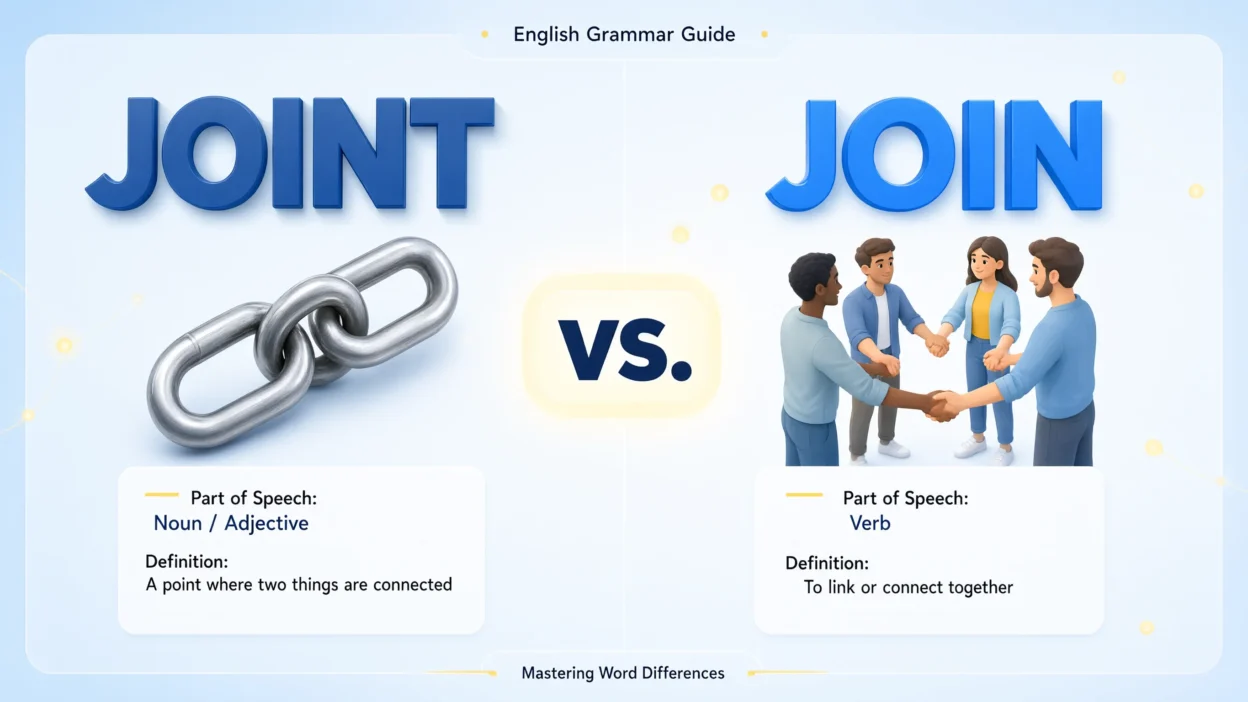
Joint and join are both correct English words, but they have different meanings. Joint is usually an adjective or noun referring to something shared or a place where things connect. Join is a verb meaning to connect, unite, participate, or become a member of something.
Why Do People Confuse Joint and Join?
People often confuse these words because they have similar spellings and pronunciations. Both begin with the letters “joi,” and their meanings can sometimes relate to connection or togetherness.
However, their grammatical roles are different:
- Joint: Usually an adjective or noun.
- Join: A verb that describes an action.
For example:
- We started a joint project. (Describes a shared project.)
- Please join our project. (Describes the action of becoming involved.)
Remember that one describes a shared connection, while the other expresses an action.
What Does Joint Mean?
Joint is a noun or adjective that refers to something shared by two or more people, groups, or things. It can also describe a place where two bones or parts of a structure meet.
Joint as an Adjective
As an adjective, joint means shared, combined, or done together by multiple people or organizations.
Examples:
- They opened a joint bank account.
- We made a joint decision.
- The two companies announced a joint project.
- My parents own a joint business.
Joint as a Noun
As a noun, joint can refer to a place where two bones meet or where two parts connect.
Examples:
- My knee joint hurts after running.
- The shoulder joint allows your arm to move.
- The plumber repaired the pipe joint.
Simple meaning: Joint refers to something shared or a point of connection.
What Does Join Mean?
Join is a verb that means to connect two or more things, become part of a group, or participate in an activity.
It describes an action rather than a shared condition.
Join as an Action
You can use join when someone connects things or brings people together.
Examples:
- Please join these two pieces of wood.
- She joined the two wires together.
- The teacher asked us to join the sentences.
Join as Participation
You can also use join when someone becomes a member of a group or takes part in an event.
Examples:
- I want to join the football team.
- She joined a new company.
- Would you like to join us for dinner?
- He joined the online class yesterday.
Simple meaning: Join means to connect, participate, or become a member of something.
Joint vs Join: Comparison Table
Here is a simple comparison to help you understand the difference.
| Feature | Joint | Join |
|---|---|---|
| Part of speech | Noun, adjective | Verb |
| Main meaning | Shared or connected | Connect or participate |
| Describes | A condition or thing | An action |
| Example | Joint account | Join a club |
| Related form | Jointly | Joined, joining |
| Pronunciation | /dʒɔɪnt/ | /dʒɔɪn/ |
The easiest way to remember the difference is that joint describes something shared, while join tells you what someone does.
When to Use Joint and Join
Choosing the correct word depends on what you want to express.
When to Use Joint
Use joint when talking about:
- Something shared by two or more people.
- A combined effort or decision.
- A connection between body parts.
- A shared business, account, or responsibility.
Examples:
- They have a joint savings account.
- We organized a joint event.
- The doctor examined my elbow joint.
- Both companies released a joint statement.
When to Use Join
Use join when talking about:
- Becoming a member of a group.
- Participating in an activity.
- Connecting separate objects.
- Meeting or coming together with someone.
Examples:
- I will join the English class.
- Can you join our team?
- Join the two pieces carefully.
- She will join us at lunchtime.
15 Examples of Joint and Join in Sentences
The following examples show how to use both words correctly in everyday English.
Examples of Joint in Sentences
- My brother and I opened a joint bank account.
- The two companies announced a joint venture.
- They made a joint decision about the project.
- The doctor examined my knee joint.
- We attended a joint family celebration.
- Both countries signed a joint agreement.
- The business partners share joint responsibility.
- Exercise can help improve joint flexibility.
Examples of Join in Sentences
- I want to join the school football team.
- Please join us for lunch tomorrow.
- She decided to join the online course.
- Can you join these two pieces of paper?
- He joined the company last year.
- My friends will join me at the restaurant.
- Everyone is welcome to join the discussion.
These examples demonstrate that joint describes something shared or connected, whereas join expresses an action.
Common Mistakes to Avoid
Even though these words look similar, using one in place of the other can change the meaning of a sentence.
Here are some common mistakes and their corrections:
| Incorrect Sentence | Correct Sentence |
|---|---|
| I want to joint the team. | I want to join the team. |
| We made a join decision. | We made a joint decision. |
| She will joint us tomorrow. | She will join us tomorrow. |
| They opened a join account. | They opened a joint account. |
| Please joint these pieces. | Please join these pieces. |
Important grammar tip: Use join after “to” when describing an action, as in “I want to join.” Use joint before a noun when describing something shared, as in “a joint project.”
What Is an Easy Trick to Remember Joint vs Join?
A simple memory trick can help you remember these words without checking a dictionary.
- Joint = Together: Think of a joint account, joint project, or joint decision.
- Join = Action: Think of joining a team, joining a meeting, or joining two objects.
Remember this simple sentence:
“We join a team to become part of a joint effort.”
Here, join describes an action, while joint describes something shared.
American vs British English: Joint or Join
There is no spelling difference between American and British English for these two words.
Both varieties use:
- Joint for something shared or a connection between parts.
- Join for connecting, participating, or becoming a member.
Examples in both varieties:
- We opened a joint account.
- She wants to join the university club.
- They made a joint announcement.
The spelling and basic meanings remain the same in American and British English.
Similar Words Related to Joint and Join
Learning related words can improve your vocabulary and make it easier to understand these terms.
| Word | Meaning | Example |
|---|---|---|
| Jointly | Together or collectively | They jointly own the property. |
| Joined | Connected or became a member | He joined the team. |
| Joining | The act of connecting | Joining the pieces was easy. |
| Junction | A place where things meet | Turn left at the junction. |
| Connection | A link between things | There is a strong connection. |
| Combined | Put together | They combined their efforts. |
| United | Joined together | The two groups remained united. |
| Partnership | A relationship involving shared work | They formed a business partnership. |
These related words help explain how connection, cooperation, and shared responsibility are expressed in English.
Final Verdict: Joint or Join?
The correct word depends on your sentence and its meaning.
- Use joint when describing something shared, combined, or connected.
- Use join when describing the action of connecting, participating, or becoming a member.
For example:
- Correct: We started a joint business.
- Correct: I want to join the business.
Both words are correct, but they cannot replace each other. Understanding their grammatical roles will help you use them confidently in speaking and writing.
FAQs:
1. What is the main difference between joint and join?
The main difference is their meaning and grammatical function. Joint is a noun or adjective that describes something shared or connected, while join is a verb meaning to connect, participate, or become a member of a group.
2. Is joint a verb or a noun?
Joint is commonly used as both a noun and an adjective. As a noun, it refers to a place where bones or other parts connect. As an adjective, it describes something shared or done together.
3. Is join a noun or a verb?
Join is primarily a verb. It describes an action, such as connecting two objects, becoming part of a group, or participating in an activity.
4. Should I write joint a team or join a team?
The correct phrase is join a team because you are describing the action of becoming a team member.
Example: “I want to join the school basketball team.”
5. What is the past tense of join?
The past tense of join is joined. Its past participle is also joined.
Examples:
- She joined the club yesterday.
- He has joined our team.
6. What does joint mean in a relationship?
In a relationship, joint usually means shared or involving two or more people.
For example, a joint decision is a decision made together by both partners.
7. Can joint and join be used in the same sentence?
Yes! Both words can appear in one sentence because they have different grammatical roles.
Example: “We decided to join a joint business project with our friends.”
Remember This
- Joint = Shared, combined, or connected.
- Join = To connect, participate, or become a member.
- Joint is a noun or adjective.
- Join is a verb.
- The past tense of join is joined.
- Both spellings are the same in American and British English.
Conclusion
Understanding the difference between joint and join is simple when you remember their meanings and grammatical roles. Use joint when describing something shared, combined, or connected, such as a joint account, joint decision, or knee joint. Use join when describing an action, such as joining a team, connecting two objects, or participating in a meeting.
Although these words look and sound similar, they are not interchangeable. Practice using them in everyday sentences to improve your English vocabulary and grammar. Remember: you join something, but something can be joint.

I’m Ethan Carter, Administrator at Instahuts. I manage content quality, improve user experience, and ensure every Instagram bio resource is accurate, creative, and helpful for users building standout online profiles.