
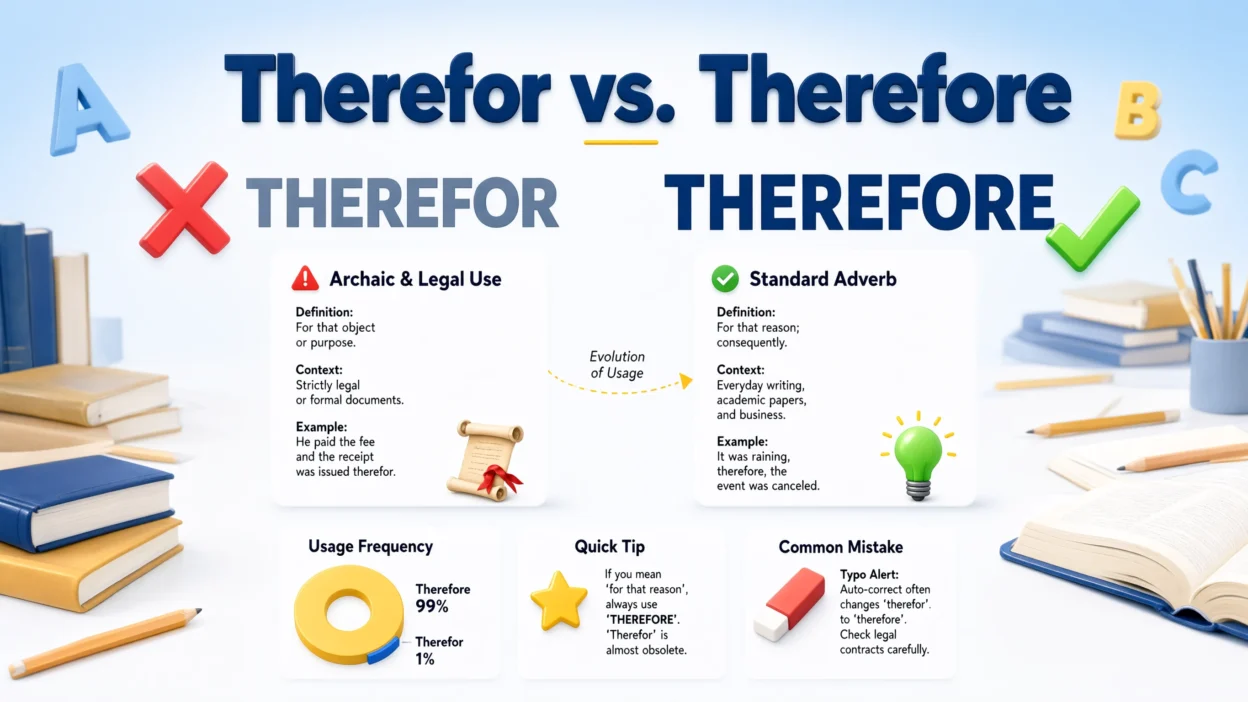
Have you ever wondered if to write therefor or therefore? These two words look almost identical, but they have different meanings and uses. Choosing the wrong one can make your writing confusing, especially in essays, emails, school assignments, and professional documents.
The good news is that the difference is easy to understand once you know what each word means. Therefore is the correct choice when you want to express a result, conclusion, or consequence. Therefor is also a real English word, but it is rarely used in everyday writing and means for that or for it. Because their spellings are so similar, many people accidentally use one instead of the other.
In this guide, you will learn the meanings of therefor and therefore, understand when to use each word, and explore practical examples. You will also discover common mistakes, simple memory tricks, and answers to frequently asked questions so you can use both words confidently.
Quick Answer
Therefore is the correct word when expressing a result, reason, or conclusion. Therefor is a rare word meaning for that or for it, usually found in formal or legal writing. For everyday English, academic writing, and professional communication, use therefore when you mean consequently or as a result.
Why Do People Confuse Therefor and Therefore?
People often confuse these words because they have almost identical spellings. The only difference is the extra letter E in therefore.
Both words are grammatically correct, but they do not communicate the same idea.
Here are the main reasons for the confusion:
- Similar spelling: Both words begin with therefor, making them easy to mix up.
- Similar pronunciation: In many accents, they sound very similar.
- Unfamiliar meaning: Many English learners know therefore but rarely encounter therefor.
- Writing mistakes: People sometimes leave out the final E when typing therefore.
- Uncommon vocabulary: Therefor appears mostly in specialized or older formal writing.
The easiest way to avoid confusion is to remember that therefore introduces a result, while therefor refers to something given or provided for something else.
1. Therefor: Meaning and Usage
Therefor is a real English word, but it is uncommon in modern everyday English.
It means for that, for it, or in exchange for that. It is generally used as an adverb, particularly in legal, financial, contractual, and formal contexts.
When Should You Use Therefor?
Use therefor when referring to something provided in exchange for, or as consideration for, something else.
Examples:
- The company received payment therefor.
- The buyer agreed to pay the full amount therefor.
- The services were provided, and compensation therefor was received.
- The contract specifies the benefits and payment therefor.
- The goods were delivered, and the agreed price therefor was paid.
Simple Explanation
In everyday English, you can often replace therefor with phrases such as:
- For that
- For it
- In exchange for that
For example:
The company received payment therefor.
This means:
The company received payment for it.
Remember that therefor is not normally used to introduce a conclusion or explain the result of an action.
2. Therefore: Meaning and Usage
Therefore is a common English adverb that means for that reason, consequently, or as a result.
It connects an idea with the logical result or conclusion that follows from it.
It is frequently used in academic writing, professional communication, essays, reports, and everyday conversations.
When Should You Use Therefore?
Use therefore when the second statement is a result or logical conclusion of the first statement.
Examples:
- It was raining; therefore, we stayed home.
- She studied hard; therefore, she passed the examination.
- The road was blocked; therefore, we took another route.
- He was feeling sick; therefore, he missed the meeting.
- The evidence was incomplete; therefore, the decision was postponed.
Simple Explanation
You can often replace therefore with:
- As a result
- Consequently
- For that reason
- Because of this
- Thus
For example:
It was raining; therefore, we stayed inside.
This means:
It was raining; as a result, we stayed inside.
Therefore makes the relationship between two ideas clear and logical.
Therefor vs Therefore: Comparison Table
| Feature | Therefor | Therefore |
| Meaning | For that or for it | As a result |
| Usage | Rare and formal | Common |
| Word type | Adverb | Adverb |
| Context | Legal and financial writing | Everyday and academic writing |
| Purpose | Refers to something provided in exchange | Introduces a conclusion |
| Example | Payment therefor was received. | It rained; therefore, we stayed home. |
Key difference: Therefor means for that, while therefore means as a result. They are not interchangeable.
When to Use Therefor or Therefore
Choosing between these words becomes easier when you understand the meaning of your sentence.
Use Therefor When You Mean For That
Choose therefor when discussing something given, paid, or provided in exchange for something else.
Examples:
- The payment therefor was approved.
- The agreement included compensation therefor.
- The company received the goods and paid therefor.
This usage is most common in formal or specialized documents.
Use Therefore When You Mean As a Result
Choose therefore when explaining what happened because of something else.
Examples:
- The weather was terrible; therefore, the event was canceled.
- She practiced every day; therefore, her performance improved.
- The shop was closed; therefore, we returned home.
A Simple Test
Ask yourself what you are trying to communicate.
- If you mean for that, use therefor.
- If you mean as a result, use therefore.
This simple test will help you choose the correct spelling in most situations.
10+ Examples of Therefor and Therefore in Sentences
Examples make the difference easier to understand. Here are practical sentences showing how both words work.
Examples Using Therefor
- The buyer paid the agreed price therefor.
- The company received compensation therefor.
- The contract clearly explains the payment therefor.
- The services were completed, and the customer paid therefor.
- The goods were delivered, and payment therefor was confirmed.
- The agreement included additional benefits and compensation therefor.
Examples Using Therefore
- She was tired; therefore, she went to bed early.
- It was getting late; therefore, we decided to leave.
- He forgot his umbrella; therefore, he got wet.
- The team practiced regularly; therefore, they performed well.
- The store was closed; therefore, we went somewhere else.
- The information was incorrect; therefore, the report needed revision.
- She missed the bus; therefore, she arrived late.
- The project was incomplete; therefore, the deadline was extended.
Common Mistakes When Using Therefor and Therefore
Even experienced writers sometimes make spelling mistakes with similar-looking words. Understanding these common errors can help you avoid them.
Mistake 1: Using Therefor to Express a Result
Incorrect: It was raining; therefor, we stayed home.
Correct: It was raining; therefore, we stayed home.
Why? The sentence describes a result, so therefore is the correct word.
Mistake 2: Using Therefore to Mean For It
Incorrect: The company received payment therefore.
Correct: The company received payment therefor.
Why? The intended meaning is payment for something, not a conclusion.
Mistake 3: Thinking Therefor Is Always a Spelling Error
Therefor is not automatically incorrect. It is a legitimate English word with a different meaning.
Mistake 4: Using the Words Interchangeably
Incorrect: She was ill; therefor, she stayed home.
Correct: She was ill; therefore, she stayed home.
Why? The sentence explains a consequence, not an exchange.
Mistake 5: Forgetting the Final E in Therefore
Incorrect: The results were clear, therefor the decision was easy.
Correct: The results were clear; therefore, the decision was easy.
Why? Therefore needs the final E when expressing a conclusion.
Memory Trick: How to Remember Therefor vs Therefore
A simple memory trick can help you remember the difference without memorizing complicated grammar rules.
Therefore = The result
Think of therefore as a word that points toward what happens next.
Example:
He worked hard; therefore, he succeeded.
His success is the result of his hard work.
Therefor = For that
Think of therefor as a shorter way of saying for that.
Example:
The company received payment therefor.
This means the company received payment for that service or item.
Easy memory tip
Remember:
- Therefore has an extra E and means consequently.
- Therefor has no final E and means for that.
American vs British English: Therefor or Therefore
There is no spelling difference between American and British English when it comes to these two words.
Both varieties use:
- Therefore to express a result or conclusion.
- Therefor to mean for that or for it.
The difference is based on meaning and usage, not regional spelling.
Examples:
American English: The weather was bad; therefore, the flight was delayed.
British English: The weather was bad; therefore, the flight was delayed.
Both sentences are correct.
However, therefore is much more common in everyday writing in both varieties of English.
Similar Words to Therefor and Therefore
Several English words have meanings related to therefore or therefor. Learning them can improve your vocabulary and make your writing more natural.
| Word | Meaning | Example |
| Consequently | As a result | He was late; consequently, he missed the train. |
| Thus | In this way or as a result | The evidence was weak; thus, the case was dismissed. |
| Hence | For this reason | She was unwell; hence, her absence. |
| Accordingly | In a way that follows from something | The rules changed; accordingly, we adjusted our plans. |
| As a result | Because of something | It snowed; as a result, school was closed. |
| For that | Referring to something previously mentioned | Payment for that was required. |
These alternatives can help you avoid repeating therefore too often.
Final Verdict: Therefor or Therefore?
Both therefor and therefore are correct English words, but they have different meanings.
Use therefore when you want to express a result, consequence, or conclusion. It is the standard choice for everyday conversations, essays, emails, and professional writing.
Use therefor when you mean for that or for it, especially in formal, legal, or financial contexts.
If you are unsure which spelling to choose, remember that most sentences explaining a result need therefore.
FAQs:
1. Is therefor or therefore correct?
Both spellings are correct, but they have different meanings. Therefore means as a result or consequently, while therefor means for that or for it. Therefore is the more common word in modern English.
2. Is therefor a real English word?
Yes, therefor is a real English word. It is an adverb meaning for that or for it. It is mostly used in formal, legal, and financial writing rather than everyday conversation.
3. What is the difference between therefor and therefore?
The main difference is their meaning. Therefor means for that or for it, whereas therefore means as a result or for that reason. They cannot be used interchangeably.
4. Why do people write therefor instead of therefore?
People sometimes write therefor because they accidentally leave out the final E in therefore. Others may use it intentionally in formal documents where it means for that or for it.
5. Can I use therefore at the beginning of a sentence?
Yes, you can begin a sentence with therefore when introducing a conclusion or result.
Example:
The roads were flooded. Therefore, the school remained closed.
6. Is therefor commonly used in everyday English?
No, therefor is uncommon in everyday English. Most people use it mainly in legal, contractual, or financial documents. In normal writing, therefore is much more useful.
7. What are the synonyms of therefore?
Common synonyms of therefore include consequently, thus, hence, accordingly, as a result, and for that reason. The best alternative depends on the sentence and its intended meaning.
Remember This
- Therefor = For that or for it.
- Therefore = As a result or consequently.
- Both spellings are correct English words.
- Therefore is much more common in everyday writing.
- Therefor is mainly used in formal and specialized contexts.
Conclusion
Understanding the difference between therefor and therefore is simple once you focus on their meanings. Although their spellings look almost identical, they serve different purposes. Therefor refers to something provided for something else, while therefore introduces a result or conclusion. Remembering this distinction will help you avoid common spelling and grammar mistakes.
For everyday writing, essays, emails, and professional communication, therefore is usually the word you need. Keep the simple memory trick in mind, practice the examples, and choose the correct word with confidence whenever you write.

I enjoy creating engaging Instagram bio ideas that inspire creativity and self-expression. My goal is to help readers craft memorable profiles with unique, stylish, and meaningful bios for every personality.