When reading a novel, watching a movie, or studying a story, you will often hear the words protagonist and antagonist. Both describe important characters, but they have different roles in a story. Understanding protagonist vs antagonist makes it easier to follow the plot, recognize character relationships, and understand how conflicts develop.
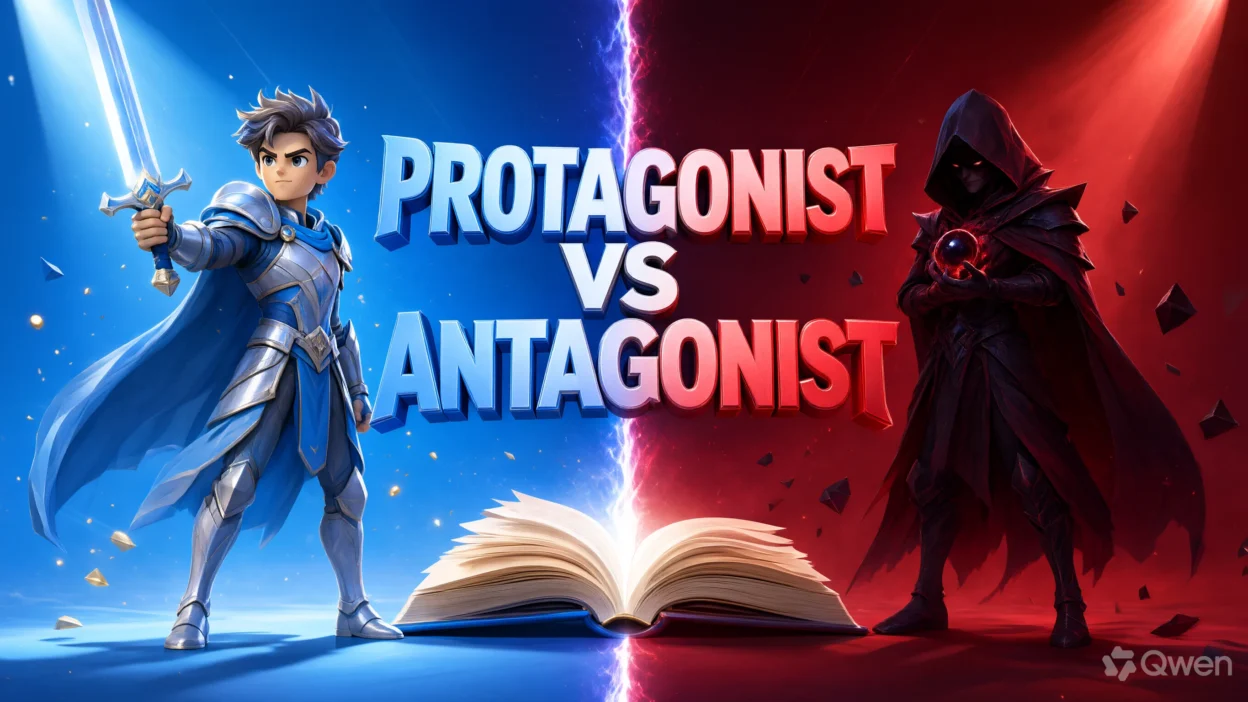
The protagonist is the central character whose journey drives the story. The antagonist is the character, group, force, or obstacle that opposes the protagonist and creates conflict. For example, in a superhero movie, the hero is usually the protagonist, while the villain trying to stop the hero is often the antagonist.
However, these roles are not always as simple as hero and villain. A protagonist can make bad decisions, and an antagonist can have understandable reasons for their actions. Learning the difference will help you analyze stories and use both words correctly in writing and everyday discussions.
Quick Answer: Protagonist vs Antagonist
A protagonist is the main character of a story, while an antagonist is the character or force that opposes the protagonist. The protagonist usually drives the plot forward, and the antagonist creates challenges or conflict. The protagonist is not always a hero, and the antagonist is not always evil.
Why Do People Confuse Protagonist and Antagonist?
People often confuse these words because both describe major roles in storytelling. They are also commonly used together when discussing books, movies, plays, and television shows.
There are three main reasons for this confusion:
- Similar context: Both terms are used to describe characters in the same story.
- Opposite roles: Their functions are connected because one usually faces opposition from the other.
- Hero and villain misunderstanding: Many people assume that protagonist always means good character and antagonist always means bad character.
The easiest way to understand them is to remember that the protagonist is at the center of the story, while the antagonist creates opposition to the protagonist’s goals.
What Does Protagonist Mean?
A protagonist is the main character around whom a story revolves. The audience usually follows this character’s experiences, decisions, challenges, and personal development.
The protagonist is often the person trying to achieve an important goal. Their actions help move the story forward and connect different events.
Examples of a protagonist:
- Harry Potter in the Harry Potter series.
- Katniss Everdeen in The Hunger Games.
- Simba in The Lion King.
- Frodo Baggins in The Lord of the Rings.
- Elizabeth Bennet in Pride and Prejudice.
A protagonist does not have to be perfect, kind, or morally good. Some stories even feature villains or morally complicated characters as protagonists.
Example sentence:
– The protagonist of the novel struggles to protect her family while facing difficult decisions.
Key Characteristics of a Protagonist
- Usually serves as the central character.
- Has a goal, desire, or personal challenge.
- Experiences important events in the story.
- Makes decisions that influence the plot.
- May experience personal growth or change.
- Can be a hero, villain, or morally complex character.
What Does Antagonist Mean?
An antagonist is a character, group, or force that opposes the protagonist. The antagonist creates obstacles, challenges, or conflicts that make it difficult for the main character to achieve their goals.
In many stories, the antagonist is the villain. However, an antagonist can also be a rival, an opposing organization, nature, society, or even an internal struggle.
Examples of an antagonist:
- Lord Voldemort in the Harry Potter series.
- President Snow in The Hunger Games.
- Scar in The Lion King.
- Sauron in The Lord of the Rings.
- Mr. Wickham in Pride and Prejudice.
An antagonist does not necessarily have to be cruel or evil. Sometimes, the antagonist believes they are doing the right thing but has goals that conflict with those of the protagonist.
Example sentence:
– The antagonist creates several obstacles that prevent the protagonist from reaching the final goal.
Key Characteristics of an Antagonist
- Opposes the protagonist’s goals.
- Creates conflict or tension.
- Challenges the main character.
- May be a person, group, organization, or force.
- Can have understandable motivations.
- Does not always have to be evil.
Protagonist vs Antagonist: Comparison Table
The following table explains the main differences between these two storytelling terms.
| Feature | Protagonist | Antagonist |
| Meaning | Central character | Opposing character or force |
| Main role | Drives the story | Creates opposition |
| Relationship | Faces challenges | Creates or represents challenges |
| Goals | Pursues the main objective | Often blocks that objective |
| Personality | Can be good or bad | Can be good or bad |
| Story position | Usually at the center | Usually opposes the center |
| Development | Often experiences a journey | May challenge the protagonist’s development |
| Common example | Hero | Villain |
| Conflict | Faces conflict | Helps create conflict |
| Main purpose | Moves the plot forward | Adds tension and challenges |
In simple words: The protagonist is the character whose story we follow, while the antagonist is the person or force standing in the way of that character.
When Should You Use Protagonist and Antagonist?
Both words are useful when discussing fiction, storytelling, literature, and character development. However, you should use them in the correct situations.
When to Use Protagonist
Use protagonist when referring to:
- The main character of a novel or story.
- The central figure in a movie or television show.
- A character whose journey drives the plot.
- The person whose experiences the audience follows.
- The central figure in a play or literary work.
Examples:
- The protagonist learns an important lesson about friendship.
- The writer introduces the protagonist in the opening chapter.
- Every major event in the movie affects the protagonist.
When to Use Antagonist
Use antagonist when referring to:
- A character who opposes the main character.
- A villain or rival in a fictional story.
- A group that creates challenges for the protagonist.
- A force that prevents the main character from succeeding.
- An opposing power that drives the central conflict.
Examples:
- The antagonist tries to destroy the protagonist’s plans.
- The author gives the antagonist a complicated personality.
- Nature becomes the antagonist in the survival story.
Protagonist vs Antagonist: 15+ Examples in Sentences
Examples make it easier to understand how these words work in real contexts.
Examples Using Protagonist
- The protagonist discovers a hidden secret about his family.
- Every reader wants to know what happens to the protagonist.
- The protagonist shows courage when facing danger.
- The author gives the protagonist a difficult decision.
- My favorite protagonist is a young girl who dreams of becoming a scientist.
- The protagonist changes significantly throughout the novel.
- The movie follows a protagonist who wants to save his hometown.
- A strong protagonist makes a story more engaging.
Examples Using Antagonist
- The antagonist tries to stop the hero from completing his mission.
- The story becomes exciting when the antagonist appears.
- The antagonist has a personal reason for opposing the protagonist.
- The writer creates a mysterious antagonist.
- The antagonist controls the kingdom and threatens its people.
- The protagonist must defeat the antagonist to achieve her goal.
- Sometimes, the antagonist is more interesting than the main character.
- The storm acts as the antagonist in the survival adventure.
Examples Using Both Words
- The protagonist and antagonist have completely different goals.
- The conflict between the protagonist and antagonist drives the story.
- A good story often gives both characters meaningful motivations.
- The protagonist eventually understands why the antagonist behaves that way.
Common Mistakes When Using Protagonist and Antagonist
Even experienced readers sometimes misunderstand these terms. Here are common mistakes to avoid.
Mistake 1: Thinking the protagonist is always a hero
Incorrect: Every protagonist must be a good person.
Correct: A protagonist can be a hero, villain, antihero, or morally complicated character.
Mistake 2: Thinking the antagonist is always evil
Incorrect: An antagonist must always be a cruel villain.
Correct: An antagonist can be a good person whose goals conflict with the protagonist’s goals.
Mistake 3: Confusing the main character with the villain
Incorrect: The villain is always the protagonist.
Correct: The villain is often the antagonist, but a villain can also be the protagonist in a story told from their perspective.
Mistake 4: Assuming the antagonist must be human
Incorrect: Every antagonist must be a person.
Correct: An antagonist can be an animal, natural disaster, society, or internal struggle.
Mistake 5: Using the words interchangeably
Incorrect: The protagonist and antagonist have the same storytelling role.
Correct: The protagonist is the central character, while the antagonist opposes that character.
What Is an Easy Memory Trick for Protagonist vs Antagonist?
Remember these simple associations:
- Protagonist = Primary character: Think of the main character whose story you follow.
- Antagonist = Against: Think of someone or something that goes against the protagonist.
Another helpful trick is to remember:
- Protagonist = The central character.
- Antagonist = The opposing force.
For example, if a story follows a detective trying to solve a crime, the detective is usually the protagonist. The criminal trying to escape justice may be the antagonist.
This simple trick can help you remember the difference whenever you read a book or watch a movie.
Protagonist vs Antagonist in American and British English
There is no meaningful spelling or definition difference between protagonist and antagonist in American and British English.
Both varieties use the same spelling and meanings.
| Word | American English | British English |
| Protagonist | Protagonist | Protagonist |
| Antagonist | Antagonist | Antagonist |
The pronunciation may vary slightly depending on the speaker’s accent, but the words have the same grammatical function and storytelling meanings.
Examples:
- American English: The protagonist faces a dangerous antagonist.
- British English: The protagonist faces a dangerous antagonist.
Both sentences are correct.
What Are Some Words Similar to Protagonist and Antagonist?
Several storytelling terms are related to these words. However, they do not all have exactly the same meanings.
| Word | Simple Meaning |
| Main character | The central character in a story |
| Hero | A character admired for courage or good actions |
| Heroine | A female hero or central heroic character |
| Antihero | A central character who lacks traditional heroic qualities |
| Villain | A character who does evil or harmful things |
| Foil | A character who highlights another character’s qualities |
| Rival | Someone competing against another person |
| Opponent | Someone who competes or fights against another |
| Supporting character | A character who helps develop the main story |
| Deuteragonist | The second most important character in a story |
Important distinction: A main character and a protagonist are often the same person, but a villain and an antagonist are not necessarily the same. These terms describe different aspects of a character’s role.
Final Verdict: Protagonist vs Antagonist
The main difference between a protagonist and an antagonist is their role in a story.
- Protagonist: The central character whose journey drives the plot.
- Antagonist: The character or force that opposes the protagonist and creates conflict.
Remember that the protagonist is not always good, and the antagonist is not always bad. Their roles depend on how they relate to the story’s central conflict, not simply on their personalities.
FAQs:
1. Is a protagonist the good guy or the bad guy?
A protagonist can be either good or bad. The word describes the central character of a story, not their moral personality. A villain can be the protagonist if the story focuses on their journey and experiences.
2. Is an antagonist always a villain?
No, an antagonist is not always a villain. An antagonist is simply a character or force that opposes the protagonist. They may have good intentions, understandable motivations, or different beliefs.
3. Can a story have two protagonists?
Yes, a story can have two or more protagonists. These characters may share the main storyline, have connected goals, or experience separate journeys that contribute equally to the plot.
4. Can the protagonist and antagonist be the same person?
Yes, some stories explore internal conflict in which a character struggles against their own fears, desires, or weaknesses. In this situation, the character can be the protagonist while their internal struggle acts as an antagonistic force.
5. What is the difference between a protagonist and a hero?
A protagonist is the central character of a story, while a hero is generally someone who displays courage, goodness, or admirable qualities. A protagonist does not have to be heroic.
6. What is the difference between an antagonist and a villain?
An antagonist opposes the protagonist, while a villain is a character who behaves in an evil or harmful way. A villain is often an antagonist, but an antagonist does not have to be a villain.
7. Can nature be an antagonist in a story?
Yes, nature can act as an antagonist. For example, a dangerous storm, freezing weather, or a wild environment can create obstacles that prevent the protagonist from achieving their goal.
Remember This
- Protagonist means the main character whose story we follow.
- Antagonist means the opposing character or force.
- The protagonist is not always a hero.
- The antagonist is not always a villain.
- Both characters help create the central conflict of a story.
Conclusion
Understanding protagonist vs antagonist is simple when you focus on their roles rather than their personalities. The protagonist is the central character who drives the story, while the antagonist creates opposition and challenges that make the journey interesting. These characters are essential to developing conflict, tension, and meaningful storytelling.
Whenever you read a novel, watch a movie, or write your own story, look at who drives the action and who stands in their way. This simple approach will help you identify both characters correctly and understand how their relationship shapes the entire story.

I enjoy creating engaging Instagram bio ideas that inspire creativity and self-expression. My goal is to help readers craft memorable profiles with unique, stylish, and meaningful bios for every personality.